View Full Version : Challenge: My oldest camera
Martin Evans
September 21st, 2010, 05:06 AM
A new photo of an old camera of mine. It is a quarter-plate "Challenge" model, by J. Lizars of Glasgow. I think it dates from about 1905 to 1914 period.
http://people.pwf.cam.ac.uk/mhe1000/Lizar/Lizar59.jpg
If you want to see any more pictures of it, when and how I came to buy it, click on
http://people.pwf.cam.ac.uk/mhe1000/Lizar/myoldestcamera.htm
Martin
Doug Kerr
September 21st, 2010, 06:16 AM
Hi, Martin,
A lovely machine, and a lovely write-up.
Thanks so much.
Best regards,
Doug
Doug Kerr
September 21st, 2010, 08:45 AM
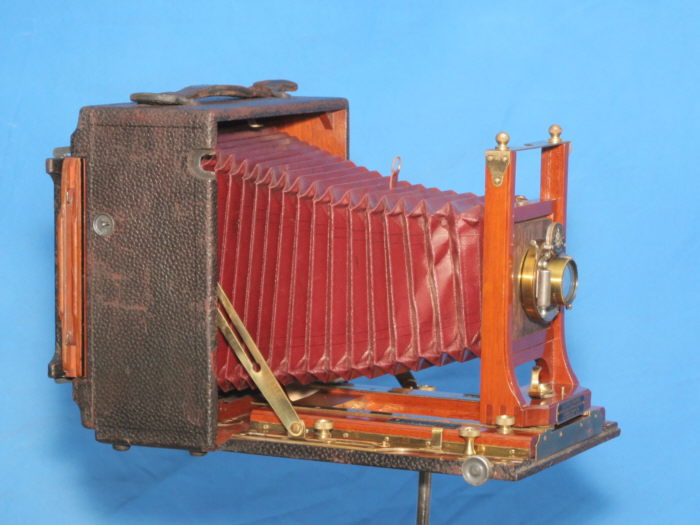
This is not our oldest camera (I actually have to ponder just which one that is), but it is one of our favorites, a 5" x 7" format Revolving Back ("R.B.") Cycle Graphic, made in about 1915 by the then-current manifestation of the Graflex dynasty, the Folmer & Schwing Division of Eastman Kodak Company:
http://dougkerr.net/images/technical/RB_Cycle_Graphic_E25165R.jpg
The term “cycle” in its name was meant to exploit the association, in the early part of the 20th century, between bicycling and photography. (Imagine schlepping such a machine, plus a box of plate holders and a spiffy Crown wood tripod, on your bicycle. Perhaps that lovely girl from the University's power lifting team would come along.)
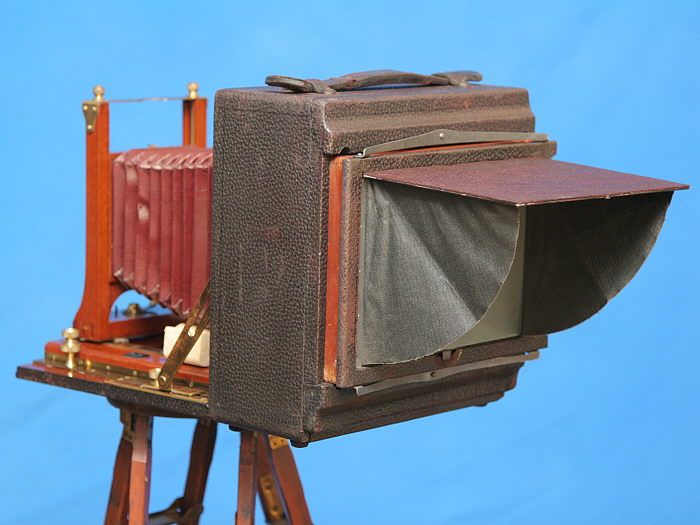
“Revolving back” means that the film may be oriented in either the familiar “landscape” or “portrait” orientation or any orientation in between with the camera in its "normal" orientation. The back has a lovely integral focusing hood:
http://dougkerr.net/images/technical/RB_Cycle_Graphic_E25123R.jpg
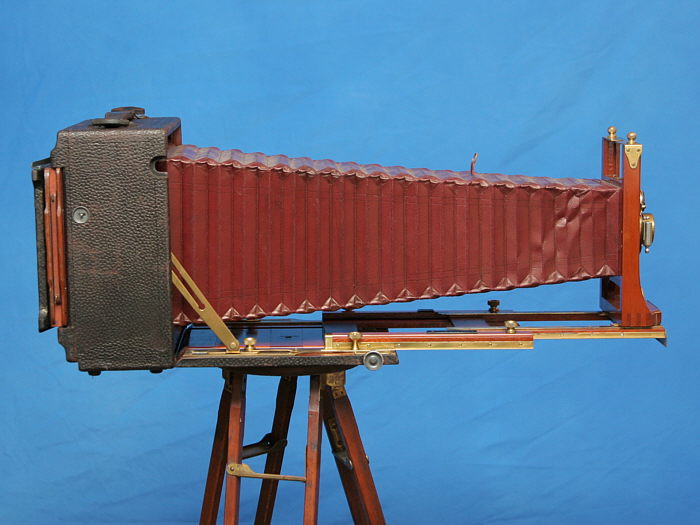
The camera has an extensible bed to provide for an extraordinary bellows extension, intended to support the possibility of serious macro work by the bicyclist-naturalist:
http://dougkerr.net/images/technical/RB_Cycle_Graphic_E25106R.jpg
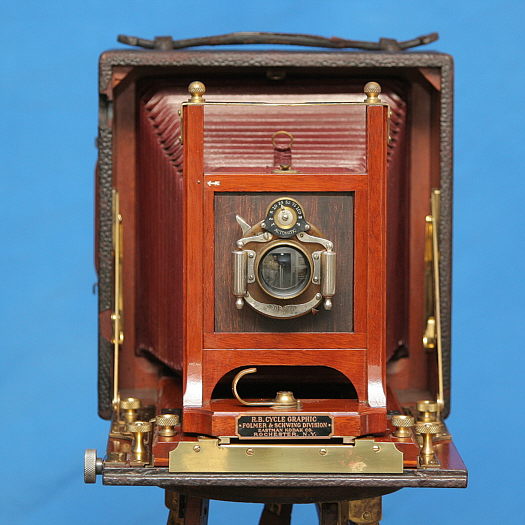
This specimen is equipped with a Rochester Optical and Camera Company “Symmetrical” lens (8” focal length, maximum aperture f/9) mounted in a Rauber and Wollensak “Automatic” shutter. The lens and shutter are believed to date from the period 1901-1903. As with the camera we just saw in Martin's post, the lens aperture setting is marked in the “Uniform System” scale, not in terms of f/number.
http://dougkerr.net/images/technical/RB_Cycle_Graphic_E25117R.jpg
The shutter offers instantaneous speeds from 1 sec to 1/100 sec, with the slower speeds timed by a pneumatic cylinder (to the right of the lens, as seen facing the shutter). It also offers the classical bulb and time modes for longer exposures.
The shutter can be tripped with a lever on the lens, or by a rubber bulb connected by tubing to a pneumatic cylinder on the left side of the lens. What looks like a hose connection on the bottom of the right hand (timing) cylinder is a dummy, included for visual symmetry.
As the name suggests, the shutter is “automatic”: it is not necessary to cock it before operating it.
The camera has a rising front, and back tilt by way of bed drop/rise, but no other movements.
The design of this camera foretold the emergence of the Speed Graphic press camera in 1912.
Further information on this model and this specimen are found in our museum catalog section for this specimen, here:
http://dougkerr.net/museum/Exhibit_RB_Cycle_Graphic.pdf
Best regards,
Doug

Asher Kelman
September 21st, 2010, 10:08 AM
A new photo of an old camera of mine. It is a quarter-plate "Challenge" model, by J. Lizars of Glasgow. I think it dates from about 1905 to 1914 period.
http://people.pwf.cam.ac.uk/mhe1000/Lizar/Lizar59.jpg
If you want to see any more pictures of it, when and how I came to buy it, click on
http://people.pwf.cam.ac.uk/mhe1000/Lizar/myoldestcamera.htm
Martin
http://people.pwf.cam.ac.uk/mhe1000/Lizar/Lizar87.jpg
Martin,
This is exciting. Do you still have plates left and also have you any of those pictures. We'd love to see them. Let me put it this way, "share them, please!". :)
"Alas, glass quarter plates for general photographic use ceased to be made about 30 - 40 years ago. Two of my dark slides still have plates in them, and this box of Ilford SR Pan plates has a couple still in their wrapping, but they are all so old that it is doubtful if they are still useable. I used the camera from time to time from the early 1950s until some time in the 1960s. At first I used to develop the plates at home, in a darkened bathroom, and made contact prints from them. Later I had access to a scientific laboratory darkroom, which made things easier. During part of my final degree year I adapted the camera for photomicrography. The lens assembly is easily removable. I made a plain wooden substitute, with a light-tight velvet lined hole that was a snug fit around a microscope draw-tube. It worked well for photographing histological specimens that I had prepared as part of my final year in the B.Sc. course, and it was fun to be able to present these prints, from a rather make-shift setup, as part of my course finals."
This is so interesting.
Asher
Timothy Bearden
October 16th, 2010, 07:21 PM
I have an old Tachihara, not nearly as old as yours. Can't beat old cameras if they still work.
Jim Galli
October 17th, 2010, 09:06 PM
This is not our oldest camera (I actually have to ponder just which one that is), but it is one of our favorites, a 5" x 7" format Revolving Back ("R.B.") Cycle Graphic, made in about 1915 by the then-current manifestation of the Graflex dynasty, the Folmer & Schwing Division of Eastman Kodak Company:
The term “cycle” in its name was meant to exploit the association, in the early part of the 20th century, between bicycling and photography. (Imagine schlepping such a machine, plus a box of plate holders and a spiffy Crown wood tripod, on your bicycle. Perhaps that lovely girl from the University's power lifting team would come along.)
“Revolving back” means that the film may be oriented in either the familiar “landscape” or “portrait” orientation or any orientation in between with the camera in its "normal" orientation. The back has a lovely integral focusing hood:
The camera has an extensible bed to provide for an extraordinary bellows extension, intended to support the possibility of serious macro work by the bicyclist-naturalist:
http://dougkerr.net/images/technical/RB_Cycle_Graphic_E25106R.jpg
This specimen is equipped with a Rochester Optical and Camera Company “Symmetrical” lens (8” focal length, maximum aperture f/9) mounted in a Rauber and Wollensak “Automatic” shutter. The lens and shutter are believed to date from the period 1901-1903. As with the camera we just saw in Martin's post, the lens aperture setting is marked in the “Uniform System” scale, not in terms of f/number.
The shutter offers instantaneous speeds from 1 sec to 1/100 sec, with the slower speeds timed by a pneumatic cylinder (to the right of the lens, as seen facing the shutter). It also offers the classical bulb and time modes for longer exposures.
The shutter can be tripped with a lever on the lens, or by a rubber bulb connected by tubing to a pneumatic cylinder on the left side of the lens. What looks like a hose connection on the bottom of the right hand (timing) cylinder is a dummy, included for visual symmetry.
As the name suggests, the shutter is “automatic”: it is not necessary to cock it before operating it.
The camera has a rising front, and back tilt by way of bed drop/rise, but no other movements.
The design of this camera foretold the emergence of the Speed Graphic press camera in 1912.
Further information on this model and this specimen are found in our museum catalog section for this specimen, here:
http://dougkerr.net/museum/Exhibit_RB_Cycle_Graphic.pdf
Best regards,
Doug
Doug, I think this is also the camera used with the #5 Cirkut Camera. You can revolve the back to a position where it comes off and the cirkut back goes on in it's place. It was available that way as an outfit. Jim
Rachel Foster
October 17th, 2010, 09:15 PM
Nice shot! Thanks for posting this.
Doug Kerr
October 18th, 2010, 08:37 AM
Hi, Jim,
Doug, I think this is also the camera used with the #5 Cirkut Camera. You can revolve the back to a position where it comes off and the cirkut back goes on in it's place. It was available that way as an outfit. Jim
Actually, the #5 Cirkut (a "Cirkut camera") was "panoramic-mode only" (the panoramic back was a permanent part). The #6 (a "Cirkut outfit") could have the panoramic back exchanged for a conventional back. As I recall, its "chassis" was indeed identical to the RB Cycle Graphic.
Thanks for the input.
Best regards,
Doug