
View Full Version : Film: Soft focus: Yogacharini Zigi
Maris Rusis
November 14th, 2010, 06:33 PM
http://farm5.static.flickr.com/4125/5177154836_22383d648a_z.jpg
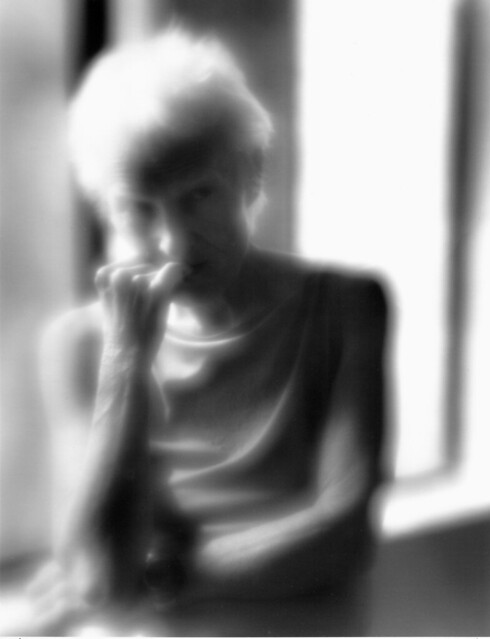
Yogacharini Zigi
Gelatin-silver photograph on Fomabrom Variant III FB VC, image area 21.3cm x 16.5cm, from a Tmax 100 negative exposed in a Tachihara 4x5 camera equipped with a 30cm f7.5 single meniscus lens.
It is a challenging thing to employ the physical structure of a lens image as a way carrying meaning in a photograph. A Yogacharini is a mystical person, a pursuer of the trancendental, a researcher in yoga rather than a mere practitioner. So what to do? Soft focus, and soft focus at the very limits of the technique where the image almost dissolves into its own kind of transcendence.
It is only on the ground-glass of a large format camera that actual image structure can be inspected with a magnifying loupe. As the aperture changes the image changes dramatically. At f8 the image is much softer than at f9. F10 is again softer than f11 and at f22 the picture is seriously sharp. A complicating factor is focus shift. Every aperture places best focus in a different plane.
More than one hundred years ago any accomplished photographer knew how to balance the variables of soft focus portraiture. Now hardly anyone knows except for Jim Galli. I hope to follow his lead at least part of the way.
Ken Tanaka
November 14th, 2010, 09:34 PM
....
More than one hundred years ago any accomplished photographer knew how to balance the variables of soft focus portraiture. Now hardly anyone knows except for Jim Galli. I hope to follow his lead at least part of the way.
Maris,
Interesting portrait. Against today's cultural backdrop it immediately invokes a visual impression of Alzheimers disease. The woman's pose and eyes really reinforce a message of dissolution.
Historical Note:
This style of portraiture was, in fact, a result of the Pictorialism movement which sought to legitimize photography as an art form, on parity with painting, by crapping-up photographic images to make them resemble a more hand-crafted work. This movement was lead principally by Alfred Steiglitz and his proponents in New York. This became the "only" legitimate style of professional photography for over approximately 40 years. It produced many wonderfully expressive bodies of works. But it also produced a lot of pure visual nonsense which mercifully came to an end when the Modernist movement took hold throughout the art world roughly after 1920.
Mark Hampton
November 15th, 2010, 02:34 PM
http://farm5.static.flickr.com/4125/5177154836_22383d648a_z.jpg
Yogacharini Zigi
Maris,
I am glad of the context for the image... light is transient... the border between things has become soft but is it soft enough?
Why focus on the hand / arm... knuckles bones skin sinew ... a dichotomy perhaps..
This gives me time... thanks for that...
Asher Kelman
November 15th, 2010, 02:51 PM
http://farm5.static.flickr.com/4125/5177154836_22383d648a_z.jpg
Maris Rusis: Yogacharini Zigi
This, Maris is a creative expression of the ideas you have on a unique person's way of being. The soft focus is a successful application here. Again I wonder the veins of the right forearm are in focus, accident or part of your design?
"A Yogacharini is a mystical person, a pursuer of the trancendental, a researcher in yoga" Is it perhaps that you are having us asking questions about the flow of blood and the flow of ideas?
Asher
Maris Rusis
November 15th, 2010, 03:36 PM
Ken Tanaka;106135]Maris,
Interesting portrait. Against today's cultural backdrop it immediately invokes a visual impression of Alzheimers disease. The woman's pose and eyes really reinforce a message of dissolution.
No Alzheimer's here. The shoot involved the photographer being punctured by some sharp wit from an amused and tolerant subject.
Historical Note:
This style of portraiture was, in fact, a result of the Pictorialism movement which sought to legitimize photography as an art form, on parity with painting, by crapping-up photographic images to make them resemble a more hand-crafted work. This movement was lead principally by Alfred Steiglitz and his proponents in New York. This became the "only" legitimate style of professional photography for over approximately 40 years. It produced many wonderfully expressive bodies of works. But it also produced a lot of pure visual nonsense which mercifully came to an end when the Modernist movement took hold throughout the art world roughly after 1920.
Ken, your historic note is spot on. When I was doing commercial portraiture some decades ago nobody used old style soft focus lenses; the results were too chancy. The studio employed Zeiss Softar filters 1, 2, and 3 in order of increasing softness. Cynically, the filter number was calibrated to the age of the female sitter. Young women got Softar #1, very old ones got Softar #3, and ancients got #1 plus #3! Filtered softness is so reliable and predictable that it was often ok to send studio junior out to do the shoot knowing it would be alright.
Maris Rusis
November 15th, 2010, 03:49 PM
http://farm5.static.flickr.com/4125/5177154836_22383d648a_z.jpg
Maris Rusis: Yogacharini Zigi
This, Maris is a creative expression of the ideas you have on a unique person's way of being. The soft focus is a successful application here. Again I wonder the veins of the right forearm are in focus, accident or part of your design?
"A Yogacharini is a mystical person, a pursuer of the trancendental, a researcher in yoga" Is it perhaps that you are having us asking questions about the flow of blood and the flow of ideas?
Asher
One does not become a Yogacharini quickly. There are years of practice, meditation, and (to my mind) excessive asceticism. The subject of this photograph is thin, wiry, amazingly flexible, and not young. Yes, the rendering of veins and bony angles is deliberate; corporeality as a counterpoint to spirituality.
Jim Galli
December 20th, 2010, 05:32 PM
Soft focus is certainly an acquired taste. Everything I need to know is in this photograph, and what is purposely held back allows my mind to complete the picture and the story. Whether I'm right or wrong is a small matter. You've allowed me that space.
Focus is what it's all about with these lenses. The choices are difficult and usually, especially with humans, you have a small time to place it and get the shot. I think you nailed it.
Maris Rusis
December 21st, 2010, 03:17 PM
Soft focus is certainly an acquired taste. Everything I need to know is in this photograph, and what is purposely held back allows my mind to complete the picture and the story. Whether I'm right or wrong is a small matter. You've allowed me that space.
Focus is what it's all about with these lenses. The choices are difficult and usually, especially with humans, you have a small time to place it and get the shot. I think you nailed it.
Thanks Jim
Following your example has helped me begin soft focus photography. Looking at your pictures has challenged me to see with new eyes.