![]() |
|
HOME
FORUMS
NEWS
FAQ
SEARCH
|
|
|||||||
| Close-up & Macro Macro and Micro Plants, insects, ice and other micro or macro artistic work |
![]() |
|
|
Thread Tools | Display Modes |
|
#1
|
|||
|
|||
|
Hi all,
This is my first post here and I must say firstly it looks like an excellent community. I am looking for some advice on firstly a suitable lens and any other advice experienced photographers can give me. I have been getting interested in taking images of insects damsel flies in particular. The problem is is obviously getting close enough to them to get a decent photo. Can anyone reccomend a suitable lens and any other kit that will allow me to get a good picture of them from a distance. thanks in advance Rob |
|
#2
|
|||
|
|||
|
Hi Rob,
I'm not a Macro guy but I've dabbled. My own favorite is the Canon ED f2.5 50mm macro, which on a x1.6 caqmera, will give you an equivalent of 80mm. Unfortunately, you need to be close. The 100mm Macros give more distance. The 100mm Canon Macro lens is thrilling in its clarity color andc sharpness. The Sigma 150 is excellent too and can be used for Nikon too. Nikon Macro is excellent and I've used the ring flash with it, (i belive it was about 75mm, I'll check.) I use mainly Canon but the nikon was awesome too. You can get a Macro lens, that is like a screw in filter that can go on top of any of your lenses. If you say what you have then people could make better suggestions. There's a lot of great macro photographers here to learn from. Asher
__________________
Follow us on Twitter at @opfweb Our purpose is getting to an impressive photograph. So we encourage browsing and then feedback. Consider a link to your galleries annotated, C&C welcomed. Images posted within OPF are assumed to be for Comment & Critique, unless otherwise designated. |
|
#3
|
|||
|
|||
|
thanks for reply Asher,
sorry if I didnt give enough the camera I use mainly is a canon eos 5d although I also have a 20d but the 5 is the most used out of the two. Rob |
|
#4
|
|||
|
|||
|
Ron,
Here is a review site - the link will take you straight to the lens I would recommend, even though I don't own any Canon equipment. I use the Pentax equivalent. Also, check out the Tamron 90 in the Canon mount... http://www.photozone.de/8Reviews/len...0_28/index.htm |
|
#5
|
|||
|
|||
|
Quote:
Damsel flies can be quite easily scared off. You will be able to get close enough (too close?) with the EF 100mm f/2.8, which also is a great general purpose lens. An even better working distance is offered by the 180 mm Macro version, but that's in a different price bracket. Depending on your other requirements, you may want to experiment with a 200mm tele with a longish extension tube. I only have a 25mm extension tube, and it allows to focus my EF 200mm f/2.8 L II to an approx. 75x110mm area (so 1:3 magnification), and at working distance from the front of the lenshood to the subject of approx. 690mm (~27inches). Bart |
|
#6
|
|||
|
|||
|
Hi Rob, and welcome to the forums.
For lens, I agree with Edward's suggestion. I have the 100mm f2.8 and I think it is fantastic. There's also Sigma and Tamron alternatives. Other equipment you may need depends on the type of macro photography you would do. For (more or less) stationary subjects, a macro rail is really, really helpful. Also some softboxes for creating a soft light. You can never have enough light for macro photography :) However, you mentioned damselflies, which are obviously not stationary, so softboxes and rails are of no use there. What is of use is a portable light. I use and like the Canon MT-24EX a lot, although maybe the MR-14EX is good enough. The photographer John Shaw describes, in his book, a home made system with two regular flashes attached to a macro bracket. I tried this and found it to be far too cumbersome, but others swear by it. Novoflex has a commercial version of this bracket here. This is describes in his book Closeups in Nature. A highly recommended book. If you want to photograph the damselflies on flight, be ready for some action :) What may help is a neat system that Gilles Martin employs. Attached to the camera is a bracket with a frame, and the distance to the frame is adjustable. The idea is to pre-focus on the frame and then chase the creature; when it is in the frame, take the shot. No need to look through the viewfinder. Underwater photographers use this method for closeups as well. This is described in Gilles' book Macrophotography: Learning from a Master. An (even more) highly recommended book. The thing to remember about damselflies and dragonflies is that they are territorial. Each damselfly will have one or two favorite perches, from which they scan the surrounding area for prey. Be patient and observe where they land regularly. Then set up beside the perch and wait. Be very still. Depending on the mag factor you want you may be able to set up a tripod, pre-focus, and use a remote shutter release to get just a bit more distance between the perch and you. The damselfly will notice that something is amiss with his perch and it can take a while for it to come back. Again...be still and be patient! Hope this helps a bit. |
|
#7
|
|||
|
|||
|
Thanks for all the help guys I think I may look into getting the 180 mm Macro, I have dabbled with macro in the past using the Canon EF-S 60mm f/2.8 Macro for a project which can be seen here not the best but obviously I suppose like anything it needs practice and experience this can be viewed here http://i168.photobucket.com/albums/u...cket/water.jpg
but obviously I need a lens than can be used further away for the subjects I am looking to take So I think I'll look into the 180 mm Macro thans again for all the input Rob |
|
#8
|
|||
|
|||
|
Hi Rob,
Basically like Kris and Bart have said, but I've not tried for damsel flies, only dragonflies and I spent some time trying, a year or so ago, but sort of gave up. There were a number of posts over on the fm site, but I can't now find them. I was told and tried that when dragionfiles are about, they like to perch a bit higher than the surrounding area. If you push a stick, (thin bamboo, or better still a small tree branch/twig) about 18 inches tall, into your lawn, and wait, sometimes only a minute or two, a dragonfly will hover for a second then perch on the tip of the stick. If you set up your camera with a telephoto lens, and gradually creep in, generally, when you are two to three feet away, it will fly away. You can set up your tripod a bit further away, then focus on the tip of the stick. The dragonfly will return within a minute or two, and you can trigger the camera when it is hovering for the half second before it lands. If you then move towards it, or cast a shadow it flies off again, giving you another chance. It will return maybe three or four times. It will often chase off a lesser df that settles on its perch. I did not have an adequate lens to get anything I was really happy with. I think you will get a hit rate of about one in every two or three hundred shots when you start. The guys on fm seemed to indicate very much that it was definitely a spray and pray technique, but I guess it depends on the fly, and time of day, etc. Its a bit like clay pigeon shooting, but quieter, maybe less cost per shot, but far more misses ;-) Damsel flies may well behave entirely differently. One guy rigged up an infra red trigger device, such that the camera fired when the beam was broken, which gave a far, far higher hit rate. It was attached to the camera, a couple of rods, about a foot apart and 18inches long, iirc, with the transmitter on one rod tip, receiver on the other. Camera focused on the beam distance, then stalk your insects, hoping it breaks the beam, which triggers the shutter. hth Best wishes, Ray (ps, if its not clear from the foregoing, I was only trying for photos of the dfs in flight. ;-)

__________________
All images posted in OPF are assumed to be for Comment & Critique, unless otherwise designated Comment Only or Edit and Repost. Last edited by Ray West; June 3rd, 2007 at 02:31 AM. |
|
#9
|
|||
|
|||
|
I found this dragonfly attached to what I think is poison ivy! He was very still (not sure why) so I just fired away.
Great tips for future attempts though!
|
|
#10
|
|||
|
|||
|
Just for fun. Here's a series from last summer. I set up beside a perch and waited. Eventually, I think it got used to me being there.
![]() ![]() ![]() I just exported these from LR, so there's no sharpening done, which the images would probably benefit from. /Kris |
|
#12
|
|||
|
|||
|
Hi Nicolas,
I don't know! How can you tell? :) |
|
#14
|
|||
|
|||
|
Rob, I have the perfect lens for you. It's the Sigma 400mm APO Macro. The claimed ratio at the closest focus (about 4 feet) is 1:3. I'm not sure how to translate that ratio for a C sensor, but on my Konica 5D it's way too much magnification to get a whole damsel/dragonfly in the frame. Gotta back off. This is a very sweet lens - I bought it years ago when Moose Peterson gave it a good review. Not made any more, I fear, and not cheap when you find them. There's nothing on ebay right now, but the last time I looked I think $400 and up was the area. If you need a macro and a tele, you can't go wrong. If you find a Sigma 400mm APO but not the APO Macro, don't buy it - it's an inferior lens.
__________________
Chuck Bragg, Los Angeles CA Konica/Minolta 5D, KM 24-50 F4, 50mm F1.7, 70-210 F4 Sigma 400mm AF APO f5.6 tele macro, KM 500mm AF Mirror Canon SD700is P&S shoots only JPGs so.... am Falling in Love with LightRoom ===== |
|
#15
|
|||
|
|||
|
Oops, there is one on ebay now, but it's in a Minolta mount. With 3 days to go it's at $150. The seller doesn't know what he has, so he's not pushing very hard. Unless someone who knows is bidding, it might be a bargain. (I'm tempted to watch and see if I can steal this one.) I saw a Questar go for $1000 some time ago because it was priced there as a Buy It Now by someone without a clue. These things happen - but not as often to Canon buyers.
|
|
#16
|
|||
|
|||
|
Quote:
How much does the Sigma 400mm Macro weigh, is it AF and what is the aperture? Seems like a great lens! Do you have pictures to share? Asher
__________________
Follow us on Twitter at @opfweb Our purpose is getting to an impressive photograph. So we encourage browsing and then feedback. Consider a link to your galleries annotated, C&C welcomed. Images posted within OPF are assumed to be for Comment & Critique, unless otherwise designated. |
|
#17
|
|||
|
|||
|
Also do you use it with a Better Beamer to get enough light?
Asher
__________________
Follow us on Twitter at @opfweb Our purpose is getting to an impressive photograph. So we encourage browsing and then feedback. Consider a link to your galleries annotated, C&C welcomed. Images posted within OPF are assumed to be for Comment & Critique, unless otherwise designated. |
|
#18
|
|||
|
|||
|
Quote:
I'll try to dig up or take a macro shot in the next day or so. |
|
#19
|
|||
|
|||
|
Hi Chuck,
Re the chip upgrade, Will Thompson is guts and has no problem taking apart a 70-200 L lens to use parts for an expensive but obselte 200 1.8 which are worth a fortune! It turns out that a lot of the parts are interchangable! I expect that's true with Sigmas. Thanks for hte task of weighing it. Do you just use it when the light is great. It seems that 5.6 would make for a dim image for manual focus. That's why I asked about flash and the Better Beamer for throwing the light far enough. Asher
__________________
Follow us on Twitter at @opfweb Our purpose is getting to an impressive photograph. So we encourage browsing and then feedback. Consider a link to your galleries annotated, C&C welcomed. Images posted within OPF are assumed to be for Comment & Critique, unless otherwise designated. |
|
#20
|
|||
|
|||
|
Since I went digital a year and a half ago I have not used flash very much. My old flash that read reflected light off the film plane doesn't work on the DSLR, and I never shot a lot of macro anyway. I do have a Better Beamer-type fresnel lens but again, I used that to get flash to birdies in the 20-50 foot distances, not for macro. Finally, my preference is to use natural light whenever possible, and what used to be unacceptable film grain at ASA 400 is now treatable noise at ASA 800-1600, so I am disinclined to lay out the big bucks on a new fancy flash unit.
|
|
#21
|
|||
|
|||
|
I tried taking a few shots with the tamron 24-135 a couple of years ago. I have some with the canon 100 macro some place but can't find them. These are nothing special but were my first try with the tamron.
![]() I show this because I'm told it is a typical hot weather pose for a male. Don't ask I don't know.
__________________
Somehow the more that I learn, the less I find that I know. Ron |
|
#22
|
|||
|
|||
|
Asher, here are a couple of photos using the Sigma, hand-held (I much prefer a tripod, but didn't have the time to wait today), ISO 200, Konica Minolta 5D with anti-shake on, taken from about 5 feet away. The wasp on the leaf was 1/125 at f/11; wasp on the branch 1/320 at f/8. The small photos are the full frame view (original size 3008x2000 RAW) close to but not at the maximum macro of 1:3; the larger photos are 100% crops, sharpened with Photo-kit.
![]() ![]() ![]()
__________________
Chuck Bragg, Los Angeles CA Konica/Minolta 5D, KM 24-50 F4, 50mm F1.7, 70-210 F4 Sigma 400mm AF APO f5.6 tele macro, KM 500mm AF Mirror Canon SD700is P&S shoots only JPGs so.... am Falling in Love with LightRoom ===== |
|
#23
|
|||
|
|||
|
Quote:
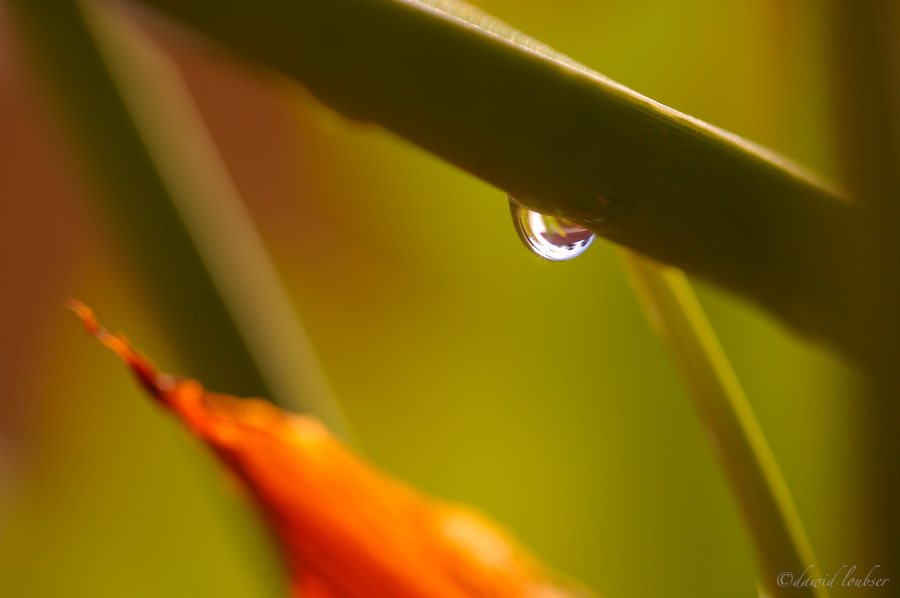
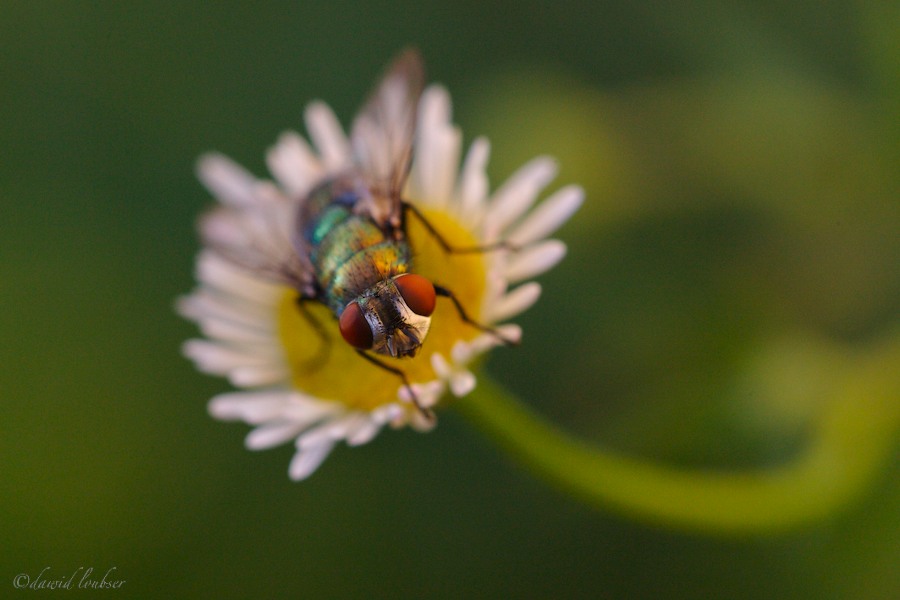
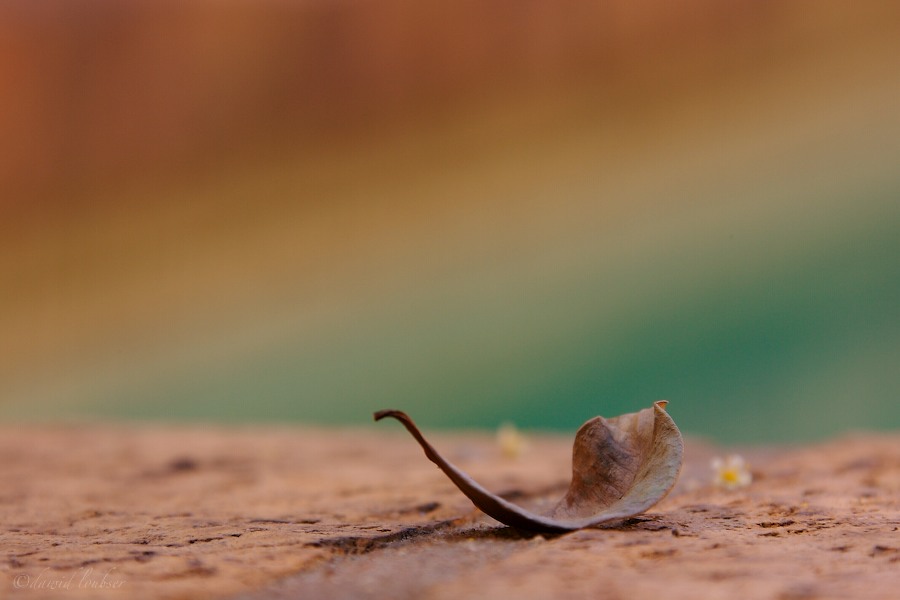
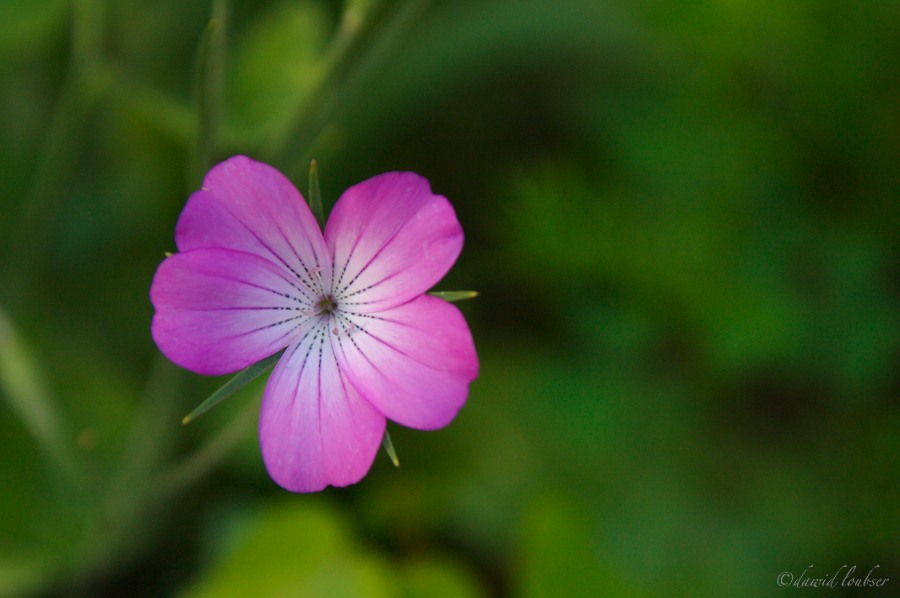
If you do hand-held photography, I can wholeheartedly recommend the Canon 100mm f/2.8 Macro. For hand-held, anything more than 100mm will not be very useful for you without an image stabiliser, as it is already very difficult to hand-hold the 100mm f/2.8 at small enough apertures to get decent depth of field, assuming you prefer natural light (I certainly do, I don't own any form of flash). The 100/2.8 has stunning colours an clarity, and is my favourite lens: Here is an example of why I love it: ![]() But, even at f/6.3, it has very shallow DOF, and the situation will only get worse with longer lenses (if you need the working distance). ![]() If I need more working distance, I usually use the Canon 28-300L because it focuses down to ~70cm (around 1:3 magnification) and it has image stabilisation. You see, depth of field is so razor thin at 300mm at close distances, that you will have to stop down to at least f/8 to get any sizeable insect in complete focus. For example, this is a small leaf at 300mm stopped down to f/10 (and not even close to closest focusing distance) ![]() Another example of the 38-300L, a small flower (sorry, I don't do many insects): ![]() Something to keep in mind is the quality of background blur, especially when you have bright bits of sunlight or sky in your background, and you have to stop down: the 28-300L has absolutely fantastic bokeh even into direct points of sunlight, whereas the otherwise great 100 f/2.8 Macro starts to look terrible when you have bright background points at apertures smaller than f/8: Here the 28-300L Here the 100 Macro But either way, just be aware of lenses longer than 100mm when you need to hand-hold. And I think that the 100mm Macro would be one of the world's perfect lenses, if it were not let down by its background blur when stopped down. Just my 2c, hope it helps! |
|
#24
|
|||
|
|||
|
Excellent demonstrations of technic with the underused 28-300 IS for macro.
Thanks Dawid! Descriptors, like "apertures smaller than f/8" may be surprisingly misinterpreted. especially by the unexperienced! Smaller circle or small f number? Maybe give the range of f stops you are referring to? Asher
__________________
Follow us on Twitter at @opfweb Our purpose is getting to an impressive photograph. So we encourage browsing and then feedback. Consider a link to your galleries annotated, C&C welcomed. Images posted within OPF are assumed to be for Comment & Critique, unless otherwise designated. |
|
#25
|
|||
|
|||
|
I mention this because there is a "brand new" Canon mount version for sale on ebay. The seller says it is not compatible with any Canon DSLR, so I checked. Sigma says only the Canon D30 and D60 are possibly compatible with the Sigma 400 tele macro f/5.6. Canon DSLRs after that are much different, they say. The lens went out of production 8-10 years ago, and they do not have parts to upgrade it.
|
|
#26
|
|||
|
|||
|
What is this flower?
Asher
__________________
Follow us on Twitter at @opfweb Our purpose is getting to an impressive photograph. So we encourage browsing and then feedback. Consider a link to your galleries annotated, C&C welcomed. Images posted within OPF are assumed to be for Comment & Critique, unless otherwise designated. |
|
#27
|
|||
|
|||
|
Hi Asher,
Sorry, I never saw your question (two months late, I know). Sorry, I have no idea what flower this is, a very small flower (you can see in relation to the blades of grass in the background) which I simply snapped during a visit to my better half's mother. And I see that many of my images have disappeared (silly DeviantArt seems to move around submitted images - sorry). |
|
#28
|
|||
|
|||
|
Quote:
Gear is good, but knowledge of the subject can do more with lesser gear. enjoy, Sean (who has yet to get a good bald faced hornet shot and wants one)
__________________
"In the End, we will remember not the words of our enemies, but the silence of our friends." - Martin Luther King Jr. (1929-1968) http://www.envisagement.com/ |
![]() |
| Bookmarks |
| Thread Tools | |
| Display Modes | |
|
|