View Full Version : Just between us gearheads - Manfrotto 410
Doug Kerr
April 22nd, 2010, 06:54 PM
I have for some while wanted a really nice three-axis geared tripod head, thinking in terms of architectural and equipment shots. macro work, and of course the infamous test shots that you know are the most prominent output of the studio here.
In honor of my 74th birthday (in about two weeks), Carla, in cahoots with some of her family, bought me a Manfrotto 410 geared head (the one they call the "Junior"). It is lovely, and only really warrants the moniker "Junior" if you're an 5x7 shooter or better.
We see it here atop my trusty Sunset tripod (from 1972 - it was bought the day William Rehnquist, later to be chief justice, was appointed to the US Supreme court), supporting an EOS 40D with an EF 24-105 f4.0L USM:
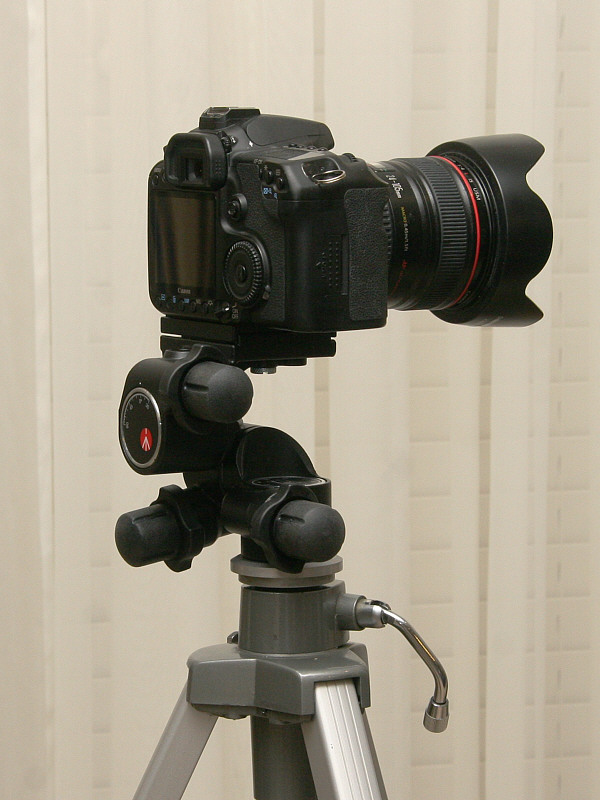
http://dougkerr.net/images/general/Manfrotto_410_E35910R.jpg
Douglas A. Kerr: Manfrotto 410
The mount is well made and very sturdy and rigid, but is not bulky, and weighs less than 4 lbs.
Each of the three axes has a nice, rubber-covered adjustment knob, with a ratio of 7.5° per turn. Behind each is a spring-loaded 4-leaf thumbwheel, which when rotated clockwise disengages the worm gear for that movement, allowing free movement on that axis. When released, the worm again engages. The increment between points of worm re-engagement is 7.5°.
The yaw axis movement is continuous. The roll axis range is to slightly over 90° to the left, slightly over 30° to the right. The pitch axis range is to slightly over 30° up (some find that a bit cramping), slightly over 90° down. The geometry is the customary roll on top of pitch. There is a solid stop at each end of the roll and pitch range. There is no play in the movements - the worms are spring loaded against the worm wheels and axially, and there is no axis wobble.
Each axis is provided with a nice angle scale, calibrated in 1° increments. But sadly they are not equipped with any sort of precision fiducial - just a little white dot several mm back from the scale.
There is a small circular spirit level that shows camera attitude.
The head has an integral Manfrotto H2 system quick release base, and comes with one plate.
The bottom of the head has a 3/6-16 female thread for attachment to the tripod. No 1/4-20 adapter bushing is provided. My tripod has a 1/4-20 interface to the head, but fortunately I had a spare adapter bushing in stock.
The provided H2 plate has both 1/4-20 and 3/8-16 fixing screws, with secure storage spots for the one not in use. Unlike the Manfrotto R2 system plates, they do not have little bails to help tighten them, so one must often resort to the "coin slot" with which they are provided.
The H2 locking system is tight and reliable. A safety catch on the release lever must be depressed before it can be actually disengaged. When the plate is removed, a locking plunger keeps the locking lever retracted. When the plate is again put in place, and is fully seated, it trips the plunger and the locking lever snaps home.
Carla, after reading some reviews by users of the head, said that it would in fact probably be quite good as our general-purpose head, not just for "gear-head" shots (however you would want to take that). She was quite right. (Ah, the wisdom of the Cherokee!) It is so easy to move quickly to the desired position, with the convenient thumb-releasing movements, that there is no reason not to use it for general work.
Overall, I am delighted by this lovely machine, and of course gratified by the thoughtfulness of Carla and her family in giving it to me.
Nill Toulme
April 22nd, 2010, 08:19 PM
It's a terrific head for copy and other precision work. And it's easy enough to bolt on an Arca-compatible clamp...
http://www.toulmephoto.com/misc/410head/081030-Bogen410-01.jpg
Nill
Asher Kelman
April 22nd, 2010, 11:02 PM
So Nill, do you have one too? Would you use it for an large format?
It's interesting and seems like a great way to have control of one's shooting platform.
Asher
Bart_van_der_Wolf
April 23rd, 2010, 02:14 AM
Would you use it for an large format?
Hi Asher,
It depends on the weight of your camera+lens.
I have a geared Manfrotto 405 geared head with a load capacity of 7.5kg, the 410 "Junior" has a load capacity of 5kg, and there is a 400 geared head rated for 10kg payloads. The 400 and 405 are big and heavy, so less suited for mobile work, unless the load capacity is required for stability.
These geared heads really shine if you need precise alignment, macro or reproduction work are obvious candidates. Architecture is another area where one can really speed up things like getting the verticals tamed (a high precision level will help in that process, although it won't automatically correct for sensor rotation).
The geared heads also do fine as general use tripod heads, perhaps a bit heavier than some simpler designs. The simpler designs ofter have some creep when being tightened which can be frustrating for precision work.
Cheers,
Bart
Nill Toulme
April 23rd, 2010, 08:24 AM
Asher it's a fairly beefy piece of kit; the "Junior" appellation is deceptive. If by "large format" you mean something like a Phase back, then I think it would probably suffice without any real difficulty. If you mean an 8x10 view camera, then I'd say you'll want to move up a model or two.
Nill
Doug Kerr
April 23rd, 2010, 08:53 AM
Hi, Asher,
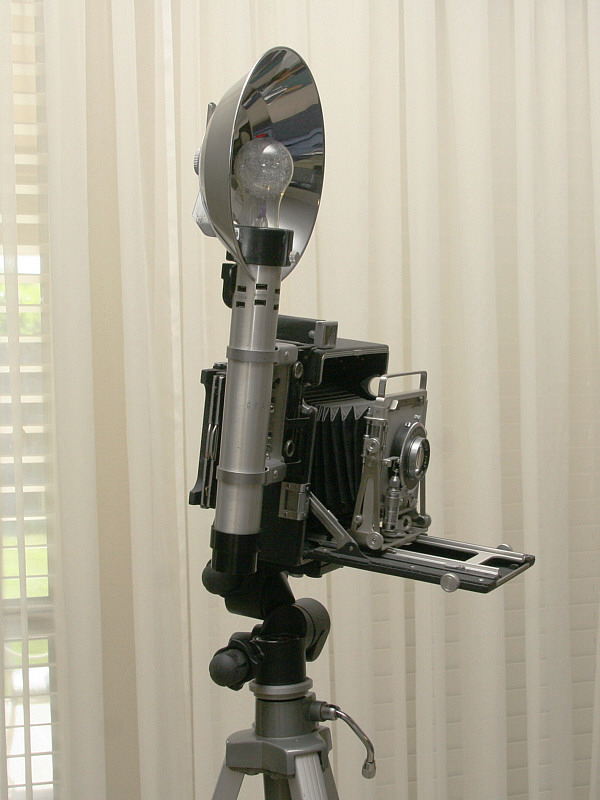
The 410 head does perfectly well with a 4x5 Crown Graphic:
http://dougkerr.net/images/general/Manfrotto_410_E35912R.jpg
Douglas A. Kerr: Manfrotto 410 gear head
The rig is rigid and stable.
(Sorry there's no sync cord on the flash for this shot!)
Best regards,
Doug
Asher Kelman
April 23rd, 2010, 12:52 PM
Off topic, but since you mentioned the synch cord, will the Copal shutter triggered by a pocket wizard reliably?
Should do but I'd though I'd ask our in-house engineer!
Asher
Ken Tanaka
April 23rd, 2010, 02:00 PM
Doug's shot with that pristine Crown Graphic wins the prize here. (Do you use that camera Doug? It looks like it's in mint condition, at least cosmetically. I almost bought one last year.)
But here's my 410 head mounted on my Manfrotto 058B Triaut (http://www.manfrotto.com/Jahia/cache/offonce/pid/2288) tripod carrying the Mamiya RZ67 Pro IID. This is an unbeatable setup for accurate studio-type shooting.
http://www.pbase.com/tanakak/image/123884802.jpg
Asher Kelman
April 23rd, 2010, 02:17 PM
But where are you getting the Polaroid film, if that's the tab showing of a Polaroid pack??
Asher
Doug Kerr
April 23rd, 2010, 02:42 PM
Hi, Ken,
Doug's shot with that pristine Crown Graphic wins the prize here. (Do you use that camera Doug? It looks like it's in mint condition, at least cosmetically. I almost bought one last year.)
No, its for static exhibit only. But we spent a lot of time on getting it in its current condition. It has a sync solenoid on it plus a sync shutter, so it can be used in either modality (and I have all the cords for either). (A common usage was with the shutter firing the flash, but the red button on the flash holder tripping the solenoid to start the whole process - it's in a handier place to push than the on-body cable release.)
But here's my 410 head mounted on my Manfrotto 058B Triaut (http://www.manfrotto.com/Jahia/cache/offonce/pid/2288) tripod carrying the Mamiya RZ67 Pro IID. This is an unbeatable setup for accurate studio-type shooting.
That is lovely.
I see you have the 410 set up for pitch-over-roll. Do find that better for your work than the roll-over-pitch usage that is implied by the "to lens" marking on the quick-release plate?
Best regards,
Doug
Asher Kelman
April 23rd, 2010, 02:47 PM
Ken,
I have the Manfrotto 475B, 3236 max load 26.6 lb as yours but it comes in at just 9.5 lb so it's lighter. I used it for the Gigapan Robot.
I notice the red tags at the top of the tripod itself, bur can't find the function. It's missing
from mine.
http://www.adorama.com/images/large/BG475B.JPG
Adorama: Manfrotto 475B
Asher
Nill Toulme
April 23rd, 2010, 06:17 PM
...I see you have the 410 set up for pitch-over-roll. Do find that better for your work than the roll-over-pitch usage that is implied by the "to lens" marking on the quick-release plate?
I have mine set up the same way. I tried briefly to follow the "to lens" marking on the plate, and it buffaloed me completely.
http://www.toulmephoto.com/misc/410head/081030-Bogen410-02.jpg
Nill
Doug Kerr
April 23rd, 2010, 07:45 PM
Hi, Nill, Ken,
I have mine set up the same way. I tried briefly to follow the "to lens" marking on the plate, and it buffaloed me completely.
http://www.toulmephoto.com/misc/410head/081030-Bogen410-02.jpg
Ordinarily in this kind of three-axis head, one wants the movements roll over pitch over yaw.
With the top movement used for roll, that means that, no matter what the elevation (pitch) setting is, movement around the roll axis rotates the camera around an axis parallel to the lens axis. Thus, unless we are working at very short distances, a roll adjustment (as for example to properly align with the horizon) does not change the point of aim - even if the camera is aimed up or down in elevation (pitch).
You are using what is intended to be the roll movement for pitch (elevation). What would normally be the pitch movement now causes something like roll, but not exactly (if the camera is pitched up or down). It rotates the rest of the mount and the camera around a horizontal axis, not necessarily around the lens axis (or one parallel to it).
It's really only a matter of taste.
Nill, I'm not sure why following the normal (and "indicated") arrangement wouldn't work for you. But perhaps sometimes the camera can't be put on the plate in a desirable way following that directive. For example, I don't mount my cameras on RC2 plates the way that is recommended, but of course then I put the RC2 base on the head to match, so the head axes work correctly.
On the 410 head, the "normal" arrangement puts the yaw (pan) knob to the right as you face the way the camera is aimed (as seen in both my pix).
Best regards,
Doug
Ken Tanaka
April 23rd, 2010, 09:27 PM
I see you have the 410 set up for pitch-over-roll. Do find that better for your work than the roll-over-pitch usage that is implied by the "to lens" marking on the quick-release plate?
Keen question, Doug. Actually, this is the only workable configuration for the RZ67 using the 410's plate directly (vs. mounting another plate above it) particularly if the left-side electronic shutter release / handle bracket is mounted (which it is, on the other side of the camera). Otherwise your fingers get pinched and certain fidgets are hard to use.
But where are you getting the Polaroid film, if that's the tab showing of a Polaroid pack??
Asher
More keen eyes! Yes, actually, that is a Polaroid back mounted in this image. I have a dwindling supply of both color and b&w Polaroid film that I'm finishing. Some of the color packs are out of date but with Polaroid..who would know or care! I like it best stale. I also sometimes use Fuji instant film with this camera.
I notice the red tags at the top of the tripod itself, bur can't find the function. It's missing
from mine.
And yet more keen eyes! The red tabs are quick-releases for the leg extensions. It makes the job of adjusting the apex height, and individual leg lengths, very smooth.
Asher Kelman
April 23rd, 2010, 09:58 PM
But where are you getting the Polaroid film, if that's the tab showing of a Polaroid pack??
Asher [/quote=Ken Tanaka]
More keen eyes! Yes, actually, that is a Polaroid back mounted in this image. I have a dwindling supply of both color and b&w Polaroid film that I'm finishing. Some of the color packs are out of date but with Polaroid..who would know or care! I like it best stale. I also sometimes use Fuji instant film with this camera.
I notice the red tags at the top of the tripod itself, bur can't find the function. It's missing
from mine.
QUOTE=Ken Tanaka;96632]And yet more keen eyes! The red tabs are quick-releases for the leg extensions. It makes the job of adjusting the apex height, and individual leg lengths, very smooth.
I wonder whether these can be added on. I may take mine back! When one is on a roof, whatever makes it easier, I want!
More keen eyes! Yes, actually, that is a Polaroid back mounted in this image. I have a dwindling supply of both color and b&w Polaroid film that I'm finishing. Some of the color packs are out of date but with Polaroid..who would know or care! I like it best stale. I also sometimes use Fuji instant film with this camera.
I have a limited supply of 8x10 color and my wife thought it would be safer to put them in the freezer like her dad used to do with all his B&W color film!!! I'm scared to look inside, LOL!
Asher
Ken Tanaka
April 23rd, 2010, 10:57 PM
The quick-release mechanism is part of the Triaut's engineering design. I can't imagine how it could be retro-fitted.
Hate to say it but freezing Polaroid film will ruin it. I've never used the sheet film but freezing smaller format packs bursts the chemical packets and also throws their chemistry into a spin. But, hey, give it a try anyway. What have you to lose? You may like the "damaged" effect.
Nill Toulme
April 24th, 2010, 07:15 AM
...
Nill, I'm not sure why following the normal (and "indicated") arrangement wouldn't work for you. But perhaps sometimes the camera can't be put on the plate in a desirable way following that directive. For example, I don't mount my cameras on RC2 plates the way that is recommended, but of course then I put the RC2 base on the head to match, so the head axes work correctly.
You know, it's been a while since I set it up, and I really can't remember, other than that trying to orient in accordance with the arrow on the plate flummoxed me entirely.
Nill
Doug Kerr
April 24th, 2010, 01:41 PM
Hi, Ken,
Keen question, Doug. Actually, this is the only workable configuration for the RZ67 using the 410's plate directly (vs. mounting another plate above it) particularly if the left-side electronic shutter release / handle bracket is mounted (which it is, on the other side of the camera). Otherwise your fingers get pinched and certain fidgets are hard to use.
I understand. As I mentioned, I have that same thing when using the Manfrotto RC2 system plates under EOS cameras, and have to put the camera on at 90° to the indicated direction. But since the QC base is not integral with the head, I can just put it on the head in the corresponding orientation to make the head axes work right (quite critical with a conventional pan-tilt head!)
With the 410 this matter is really only of trivial consequence for most work, given that the top two movements have the same kind of mechanism (even the same angular range).
Thanks for the fill-in.
Best regards,
Doug
Asher Kelman
April 24th, 2010, 03:42 PM
It's a terrific head for copy and other precision work. And it's easy enough to bolt on an Arca-compatible clamp...
http://www.toulmephoto.com/misc/410head/081030-Bogen410-01.jpg
Nill
Tricked out nicely, just as I need!. How many screws to stop it rotating?
Asher
Doug Kerr
April 24th, 2010, 04:17 PM
Hi, Asher,
Tricked out nicely, just as I need!. How many screws to stop it rotating?
If you are speaking about the head rotating on the tripod column, there is nothing on the head to stop that. Manfrotto tripods often have three screws in the column-top plate for that.
If you are speaking of the Arca-compatible clamp plate rotating on the top of the head, all that the head RC4 plate actually has is a conventional 1/4-20 or 3/6-16 tripod screw (with knurled head and coin slot).
But perhaps the clamp plate has some provision for indexing it to the RC4 plate on the head. Nill will know that.
Best regards,
Doug
Asher Kelman
April 24th, 2010, 04:21 PM
Hi Doug,
Appreciate the insight on fitting the Arca Swiss plate. Do you have any knowledge of the 405 Geared head? My local store has that in stock. It's more expensive and about 5lb in weight. Maybe that's better for my 8x10 camera too. It comes in at $400 as opposed about $220.
It seems to have a different arrangement of the gears.
Asher
Doug Kerr
April 24th, 2010, 05:04 PM
Hi, Asher,
Hi Doug,
Appreciate the insight on fitting the Arca Swiss plate. Do you have any knowledge of the 405 Geared head? My local store has that in stock. It's more expensive and about 5lb in weight. Maybe that's better for my 8x10 camera too. It comes in at $400 as opposed about $220.
It seems to have a different arrangement of the gears.
http://images.manfrotto.com/imageservlet/image?sysid=125449689496828804&format=gitzo_product_big&refresh=null http://images.manfrotto.com/imageservlet/image?sysid=125449488179686910&format=gitzo_product_big&refresh=null
Manfotto 405, seen from "in front, to the left"
Manfrotto 410, seen from "behind, to the right"
The knobs are in different locations, and are a little different style; the axis disengagement is with a round coaxial knob rather than a "thumbwheel".
But is conceptually the same, as near as I can see.
Best regards,
Doug
Bart_van_der_Wolf
April 24th, 2010, 05:21 PM
Hi Doug,
Appreciate the insight on fitting the Arca Swiss plate. Do you have any knowledge of the 405 Geared head? My local store has that in stock. It's more expensive and about 5lb in weight. Maybe that's better for my 8x10 camera too. It comes in at $400 as opposed about $220.
It seems to have a different arrangement of the gears.
Asher
Hi Asher,
The 405 has roll/rotate over pitch for the reasons Doug mentioned, when the camera is mounted as suggested, and indeed it is almost twice the price of the 410. It's big and beautiful ...
An Arca-Swiss style of clamp can be fitted to the QR-plate. The threaded RRS B2-Pro screw knob style clamp will fit the 3/8th" screw of the QR plate just fine.
As an alternative, I should mention the Fanotec/Nodal Ninja EZ-leveler II (http://store.nodalninja.com/product_p/ezl-ii-c.htm). This is more oriented towards panoramic use, but it does fine at that with it's rated 10 Kg load capacity. The leveling is limited to only a few degrees, so one needs to set-up the tripod for the majority of the leveling and then fine-tune with the EZ-leveler II. It's a very light weight and compact solution.
Cheers,
Bart
Doug Kerr
April 24th, 2010, 05:37 PM
Hi, Bart,
As an alternative, I should mention the Fanotec/Nodal Ninja EZ-leveler II (http://store.nodalninja.com/product_p/ezl-ii-c.htm). This is more oriented towards panoramic use, but it does fine at that with it's rated 10 Kg load capacity. The leveling is limited to only a few degrees, so one needs to set-up the tripod for the majority of the leveling and then fine-tune with the EZ-leveler II. It's a very light weight and compact solution.
Well, a leveler certainly doesn't do anything that a geared head does.
But it could be very advantageous to have one under the geared head (so as to get the pan axis of the head truly vertical).
Best regards,
Doug
Doug
Asher Kelman
April 24th, 2010, 06:53 PM
Hi, Bart,
Well, a leveler certainly doesn't do anything that a geared head does.
But it could be very advantageous to have one under the geared head (so as to get the pan axis of the head truly vertical).
Best regards,
Doug
Doug
http://store.nodalninja.com/v/vspfiles/photos/EZL-II-C-2.jpg
For $109 this is a big bargain and can hold 10 Kg!
Yes it would be great to level the 405 Manfrotto grared head.
Doug Kerr
April 24th, 2010, 07:10 PM
Hi, Asher,
http://store.nodalninja.com/v/vspfiles/photos/EZL-II-C-2.jpg
For $109 this is a big bargain and can hold 10 Kg!
Yes it would be great to level the 405 Manfrotto grared head.
Indeed.
Note that you might want to make some arrangement for a circular spirit level on the top plate of the leveler so you can see when it has done its job (disappointing it doesn't include one). (My usual pan-tilt head has a spirit level on its bottom layer, but I put that on!)
Once could also put one on the azimuth scale disc of the Manfrotto 410 (I'm not sure if the 405 has one - I can't tell from the only picture I have at hand at the moment.)
I may in fact do that!
Best regards,
Doug
Doug Kerr
April 24th, 2010, 07:25 PM
Ah, the 405 already has a spirit level on its bottom layer (what is needed to guide the use of the leveler):
http://www.manfrotto.com/webdav/site/manfrotto/shared/webphotoschool/_055DB_3011BN____405_3-Way__Cobra_on_the_Water/1112307838_250x250_fig-8.jpg
as well as one on its topmost layer (camera attitude) (it can be seen in my earlier picture of the 405).
The 410 has a spirit level on its topmost layer (camera attitude) only (it can be seen in my earlier picture of the 410).
Interesting!
Best regards,
Doug
Asher Kelman
April 25th, 2010, 01:18 AM
Doug, Bart and Nill
I really appreciate sharing these insights. Mechanical platforms make the lenses we spend a lot on worth having. I'm seriously interested in the 405 and that leveling plate. Would be great for my 8x10, 5DII stage pictures and architecture with a Gigapan robot. A love well thought out gear!
Asher
Doug Kerr
April 26th, 2010, 10:19 AM
Full control over the "situation" of an object in three-dimensional space requires control of six parameters (the object is said to have "six degrees of freedom"). Most commonly, this is done with three "location" (Cartesian) parameters and three "attitude" (angular) parameters.
There are numerous ways in which these can be defined, a situation that essentially parallels our concern with the "order of stacking" of movements in our camera mounting arrangements.
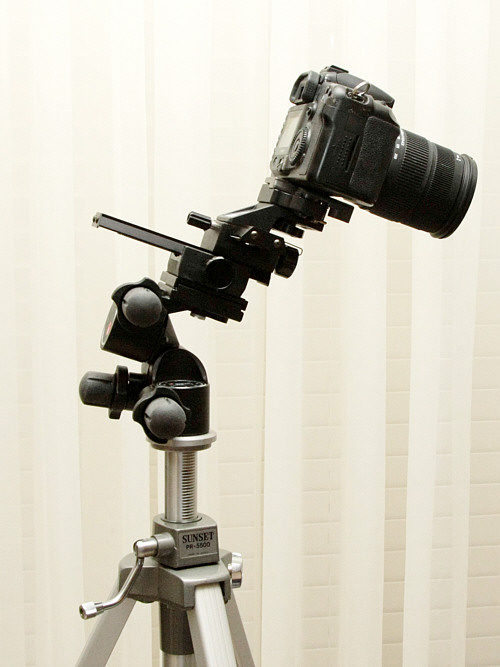
For "table-top" macro work, I now arrange the six degrees of freedom for the camera by putting my Adorama two-axis macro rail unit atop my Manfrotto 410 geared head:
http://dougkerr.net/images/general/Manfrotto_410_F15506R.jpg
Here we have two of the Cartesian parameters on top (in the Adorama rail unit), three angular parameters under that (the Manfrotto head), and the third Cartesian parameter at the bottom (the geared elevator column on the tripod).
I will discuss the philosophical implications of this "stacking" later. Suffice it to say, it seems well suited to most of my work.
The whole setup is extremely stable, and well-behaved, mechanically with this camera/lens load.
Best regards,
Doug
Asher Kelman
April 26th, 2010, 10:40 AM
~ $400 plus tripod, not really a lot of $ to get that much freedom!
I's prefer that they gave an option of an Arca Swiss fitting. Each time one connects extra things there's another degree of potential looseness.
I use the well engineered Manfrotto stage and that works but I may switch to RRS so it's all in one.
Asher
Asher
Doug Kerr
April 28th, 2010, 09:40 AM
Those who are intersted in experimenting with multi-image panoramic photography but are not yet ready to spring for a genuine panoramic head setup (we'll see a picture of a nice one later), but who have a Manfrotto 410 (or 405) geared head will find that, in some situations, quite practical panoramic work can be done with it alone (and even better with the addition of a two-axis macro focusing rail).
If our situation involves only "far-field" objects (as in much true landscape panoramic work), and thus we can essentially ignore the matter of parallax caused by use of an inappropriate axis of rotation, the 410 or 405 head can be used alone.
Indexing between shots can be readily done using the yaw angle movement. On the 410, one "tooth position" (when we have released the worm) corresponds to an increment of 7.2° (precisely 1/50 of a circle). On the 405, the increment is about 6.545° (precisely 1/55 of a circle - go figure).
Any desired incremental angle can be easily attained by counting turns of the knob (or even fractions - on the 410, the knob has four flutes around its perimeter, handy for that).
For multi-row panoramic arrays, the pitch angle movement has the same setup.
If our scene will include "near-field" elements, so that we must be concerned with parallax, a convenient accessory to the 410 or 405 head is a two-axis macro focusing rail (such as the Adorama model you may have seen earlier in this series). We see this setup here (with a 410):
http://dougkerr.net/images/general/Manfrotto_410_F15513R.jpg
The lateral movement of the rail allows us to get the lens axis over the yaw angle axis of the head. The longitudinal ("focusing") movement allows us to get the entrance pupil of the lens over the yaw angle axis of the head, with this caveat:
Unlike the situation with a bona fide panoramic head, in this rig, the pitch angle axis does not pass through the lens axis (it is about 7" "below"). Thus, the ideal pivot situation for single-row panoramas (regarding the location of the entrance pupil) is disrupted by pitch angle movement. That means that precise adjustment of the longitudinal slide needs to be made after the pitch attitude to be used is determined and set. And for multi-row images, rigorous maintenance of the ideal panoramic axis is impractical.
As I suggested earlier, these difficulties may be of little or no practical importance unless there are near-field objects in the scene.
Those who carefully look for anomalies in pictures (aha! note the prop department item sticker on the bottom of that Western Electric 500D telephone set!) may note that the Adorama rail in the picture above is configured differently than in the prior picture. There are four ways this rig can be assembled, so as to make the camera platform extend either "inboard" or "outboard", and to control which side the "focusing" knob lies (on one side or another, it may interfere with whatever is below).
I normally keep mine in a configuration different from "factory". For this setup, I had to use a different "non-factory" configuration yet.
The reconfiguration is easily done.
For clarity, in this picture, the camera was mounted directly to the camera platform of the Adorama rail unit (no quick disconnect rig being used there - I normally have a Manfrotto "RC2-style" quick disconnect assembly there).
The careful observer may also note, atop the yaw angle axis scale plate, a small circular spirit level (an addition here). It allows me to be certain that the head "base" is level. (The Manfrotto 405 has such built in.)
By the way, for fanciers of the Adorama two-axis rail (an admirable item, in my estimation), I note that the price has now risen to $179.95. Adorama now carries a "lite/budget" version, at a price of $79.95. I don't know anything about it, except that from the pictures it seems to have about the same configuration.
Now, before whoever it is here that always tells me "you can't be a professional photographer without professional equipment" (and I certainly do not pose as a professional photographer, so I'm not sure of his point) get his knickers in a twist (that's the golfing pants), lets look at a real panoramic head, the Really Right Stuff "full boat":
http://reallyrightstuff.com/pano/UltimatePro_front.gif
This in fact allows us to arrange for both yaw angle and pitch angle axes to pass through the entrance pupil of the lens (or through the camera serial number plate, if we heard somewhere that's where they ought to go).
As seen in the picture, the "list" price of that rig is about $955. It looks really nice.
Now if you had one of those, plus a Manfrotto 410, plus an Adorama two-axis rail, plus a really nice tripod, you'd be ready for a lot of different projects.
Best regards,
Doug
Doug Kerr
April 28th, 2010, 09:55 AM
Tomorrow: How to keep calcium deposits off your shower door with a Manfrotto 410 geared head. (There will be a special appendix for the butlers of Manfrotto 405 owners.)
Best regards,
Doug
Ken Tanaka
April 29th, 2010, 02:47 PM
Just for the record, Doug...
This thread prompted me to revisit the camera/head orientation with my RZ67 Pro IID and the Manfrotto 410. With some -ahem- coaxing (and an impromptu spacer between the bottom plate and camera body) I discovered that I could maintain the "proper" orientation. I've yet to discover an advantage for my own usage but clearly some engineer (an addition to you) has given this matter some thought and placed an orientation guidance on the plate.
But I do now have to re-learn each of the three rotation knobs...no small feat.
Anyway, thank you for delving into this little corner.
Doug Kerr
April 29th, 2010, 03:29 PM
Hi, Ken,
Just for the record, Doug...
This thread prompted me to revisit the camera/head orientation with my RZ67 Pro IID and the Manfrotto 410. With some -ahem- coaxing (and an impromptu spacer between the bottom plate and camera body) I discovered that I could maintain the "proper" orientation. I've yet to discover an advantage for my own usage but clearly some engineer (an addition to you) has given this matter some thought and placed an orientation guidance on the plate.
But I do now have to re-learn each of the three rotation knobs...no small feat.
Well, some "improvements" do that. Sorry to have screwed up what was seemingly working fine!
Best regards,
Doug
Bart_van_der_Wolf
April 29th, 2010, 03:57 PM
Anyway, thank you for delving into this little corner.
Agreed, and thus ditto.
Doug, thanks for reviving some (fond) memories I had about programming 3D Euler orientations in software. Order matters!
For some reason, probably the fond memories, I've used the orientations indicated on the QR-plate and have not needed to deviate as forced by platform restrictions. I do admit to occasionally rotate the camera 180 degrees on the QR-plate, when I need to exceed the 30 degree pitch up orientation (e.g. when trying to shoot things high up, like the moon).
Cheers,
Bart
Doug Kerr
April 30th, 2010, 10:24 AM
There are some interesting wrinkles when using the Adorama two-axis focusing rail with a Manfrotto 410 gear head for macro work.
Here we see an example:
http://dougkerr.net/images/general/Manfrotto_410_F15529R.jpg
The subject is the shutter speed plate on a Graflex SLR (3-1/4 x 4-1/4, c. 1922).
The camera is a Canon EOS 20D, bearing a Canon EF-S 60 mm f/2.8 USM macro lens. The lens was set for closest focus (leading to an image magnification of about 1:1).
The configuration of the Adorama rail used here is the one that provides best access to the controls and a good location of the camera center of gravity.
But as you can see, with this arrangement it may be difficult to position the camera properly. The tripod may be too close to the stable, for example, when doing a "table-top" shoot. In this particular case, the tripods had to be in full missionary position.
In addition, the focusing slide itself projects well in front of the camera body, and so it can itself interfere with the subject (especially for physically-short, and short focal-length, lenses).
Here we see an alternate configuration of the Adorama unit that alleviates these problems:
http://dougkerr.net/images/general/Manfrotto_410_F15530R.jpg
One might think that to get this we just mount the whole Adorama unit reversed atop the Manfrotto head, but in fact if doing so, the focus knob interferes with the Manfrotto QR plate. Thus, it is necessary to reverse the focusing slide in the Adorama unit. This is very easy to do. The trapezoidal end stop is removed (two truss-head Phillips screws). The slide is extracted from the carrier, reversed, and replaced. (You have to pay a little attention to the proper re-engagement of the helical gear into the rack, but this is not tricky at all - you just need to be aware of it.)
If even more protuberance of the lens is needed, there is this third configuration:
http://dougkerr.net/images/general/Manfrotto_410_F15531R.jpg
Compared to the previous configuration, this additionally requires the cross-slide to be reversed in its carrier (done exactly the same way as reversal of the focusing slide).
This is an actual shot of the subject (full-frame) done with the first configuration. (This was actually done with a 40D and the same lens.)
http://dougkerr.net/images/general/Manfrotto_410_F15519R.jpg
I wasn't as careful as I should have been in getting the roll angle exactly right (I was in a bit of a time pinch when this happened).
I suspect the situation with a Manfrotto 405 gear head would be essentially the same.
Best regards,
Doug
Bart_van_der_Wolf
May 5th, 2011, 08:35 AM
If you are speaking of the Arca-compatible clamp plate rotating on the top of the head, all that the head RC4 plate actually has is a conventional 1/4-20 or 3/6-16 tripod screw (with knurled head and coin slot).
For those with of us with a Manfrotto geared head (types 405 or 410), I recently found a better solution to avoid camera or lens twisting issues when the Arca style clamp comes loose from the quick release plate. There is a replacement plate available with an Arca style clamp which can be mounted in 90 degee intervals: Hejnar Arca Swiss conversion for Manfrotto 405/410 (http://cgi.ebay.com/ws/eBayISAPI.dll?ViewItem&item=230614227757) .
Since the US$ to Euro exchange rate is currently favourable for Europeans, I thought why not stimulate the US economy a bit and do myself a favor at the same time. So I ordered the item and within a few hours I got confirmation from the seller that the item had shipped, and a week later the package was delivered.
All that needs to be done is remove the original QR lever. The package comes with 3 hex keys to fit the various screwhead sizes, but I needed an additional wrench/spanner to loosen the lever. It's not too difficult to reassemble should one wish to sell the head in its original state (just don't lose the springs). The Arca style clamp is bolted onto the plate with 3 screws, and the plate is screwed on the head 'permanently' with one bolt. The plate cannot twist. I would have preferred a second screw but then, how likely is a screw in this position to break?
The Clamp construction is of reasonably good quality, only slightly (!) less refined than the RRS alternative, so I bought both instead of only the plate. This way I knew that the screw hole positions in the clamp would definitely fit with the plate, and I wouldn't have to screw my other RRS clamp on and off when I use it in a different configuration.
My gamble (you never know when buying on the web) worked out fine.
Cheers,
Bart
Asher Kelman
May 8th, 2011, 11:38 PM
For those with of us with a Manfrotto geared head (types 405 or 410), I recently found a better solution to avoid camera or lens twisting issues when the Arca style clamp comes loose from the quick release plate. There is a replacement plate available with an Arca style clamp which can be mounted in 90 degee intervals: Hejnar Arca Swiss conversion for Manfrotto 405/410 (http://cgi.ebay.com/ws/eBayISAPI.dll?ViewItem&item=230614227757) .
Bart,
Thanks for updating this important thread. Let us know how the adapter stands up to your regular use. One thing to watch out for is the occurrence of Arca plates that are just a mm or so wider. This I found with larger platforms from Sunway Foto. A larger Arca clamp can hold both sizes of plate. I wonder whether this Henjar adapter is a standard width.
Asher
Bart_van_der_Wolf
May 9th, 2011, 01:59 AM
Bart,
Thanks for updating this important thread. Let us know how the adapter stands up to your regular use. One thing to watch out for is the occurrence of Arca plates that are just a mm or so wider. This I found with larger platforms from Sunway Foto. A larger Arca clamp can hold both sizes of plate. I wonder whether this Henjar adapter is a standard width.
Hi Asher,
The clamp is a screw knob type, not a lever type. That will allow it to adjust to any width of rails or lens/camera plate. The clamp can be opened very wide, to allow removal/insertion of the whole bar/plate. This allows bars/plates with stop screws at their bottom to be used, they can slide in the clamp when loosened a bit but not fall out, unless the clamp is opened wide. A geared head is not for fast paced work, so a screw knob clamp is a good fit IMHO, and it accomodates all sorts of manufacturing tolerances.
Cheers,
Bart
Asher Kelman
May 9th, 2011, 08:04 AM
Hi Asher,
The clamp is a screw knob type, not a lever type. That will allow it to adjust to any width of rails or lens/camera plate. The clamp can be opened very wide, to allow removal/insertion of the whole bar/plate. This allows bars/plates with stop screws at their bottom to be used, they can slide in the clamp when loosened a bit but not fall out, unless the clamp is opened wide. A geared head is not for fast paced work, so a screw knob clamp is a good fit IMHO, and it accomodates all sorts of manufacturing tolerances.
This combination, then, Arca Swiss clamp and the geared head makes perfect sense for demanding work. I like the idea for large format photography where one is composing exactly as one would want to print. The precision would also be welcome for complex panoramas with many pictures. It's cost, added weight and extra length are then well justified.
Asher
Bart_van_der_Wolf
May 9th, 2011, 08:52 AM
This combination, then, Arca Swiss clamp and the geared head makes perfect sense for demanding work. I like the idea for large format photography where one is composing exactly as one would want to print. The precision would also be welcome for complex panoramas with many pictures. It's cost, added weight and extra length are then well justified.
Indeed, and it's very useful for table-top and especially macro photography. When shooting at 5:1 magnification, it's easy to lose the subject from the viewfinder when moving the tripod/head. The viewfinder is already very dark, and any motion is amplified. The gearing allows to make fine adjustments.
Cheers,
Bart