PDA

View Full Version : Perched Birds Show and Tell


Mike Spinak
October 11th, 2006, 03:07 PM
Bev Sampson expressed an interest in showing pics of perched birds. Sounds good to me, so... here's another show and tell thread, about perched birds. I'm hoping we can get a thread rolling for displaying and discussing lots of perched bird photos.

Please, let's try to do the following:

1) Discuss what you show, so that we can all learn from each other's techniques and ideas;

2) Post only one picture per post, or one related series per post, in order to minimize confusion.

Like this:


http://www.mikespinak.com/images/U1022_snowyegretwindruffled.jpg

Wind Ruffled Snowy Egret

© Mike Spinak

This picture was taken with an aperture of f/8, at 1/1,600 of a second, at ISO 400, with a Canon 1Ds Mark 2, a Canon 600 f/4 IS lens, and a 2x teleconverter, on a tripod, with a cable release, and the mirror locked.

I took this at a rookery where lots of snowy egrets, great egrets, and black crowned night herons raise their chicks. This was taken at the time of year when the snowy egrets have moved in, started claiming spots, started displaying to attract mates, and started defending their territory... lots of action, all the time. This egret had developed its fluffy breeding plumage, and was perched on a palm tree, where it was occasionally displaying, occasionally defending its territory, and frequently being harrassed. Meanwhile, the wind was blowing fairly hard, making the ruffled feathers on the birds look rather unkempt. I wanted to make a portrait of a bird right after it had ruffled its fluffy feathers in response to an interloper, and then become disheveled by the breeze. I wanted a portrait where the feet were visible, the background was clean, and the bird had a humorous expression. This is one of the ones I ended up with.

Let's see your perched shots, and hear the stories of how you got them.

Mike

www.mikespinak.com

(edited to fix a silly error; thanks, Don)

Bev Sampson
October 12th, 2006, 04:56 PM
Here is a contribution. Hopefully it will spark more interest in this thread.

http://www.pbase.com/bas1/image/68443130.jpg

This is a blue heron, white morph, I think. Please correct me if I am wrong. It was taken at Ding Darling in April of 2005. At that time even though it was after Hurricane Charley, there was a substantial number of beautiful birds. 2006 was another story. Hopefully things will be good again this winter.

Camera settings: Manual, manual settings by in-camera partial metering, ISO 250, F8, 1/1250, lens 1000mm (Canon 500 F4 + Canon 2X TC.

Comments are welcome.

I am waiting for the new OPF gallery to open so that I do not need to permanantly like to my pbase files.

Bev

Don Cohen
October 12th, 2006, 06:12 PM
Mike - A very successful image. You had an image in mind, set up a game plan, followed it, and came out with a beautiful image. Good planning can pay off, although as I'm sure you've also found, I'll often go out wanting to get a particular image, it doesn't work, and a completely unexpected one comes along!

BTW, you inadverently refer to "Birds in Flight" shots at the end of your post starting this thread :)

Bev - A very interesting image! My guess it that this is a Juvenile Little Blue Heron. The juveniles are all white, and this one looks like it's on the verge of gettings its adult coloration (a few dark patches are seen on its back, neck and head. I checked Sibley's and Kaufman's, and didn't find any reference to a White Morph of this particular species (which is known to occur with Great Blue Herons and Reddish Egrets). But I definitely do not consider myself a "birder" by any stretch of the imagination, so would welcome being corrected if I'm barking up the wrong tree!

I've been down to Ding Darling a number of times in recent years, and my March, 2006 visit was quite disappointing. Please keep us posted how things are this coming season.


Back to the thread's topic, here's a slight twist:

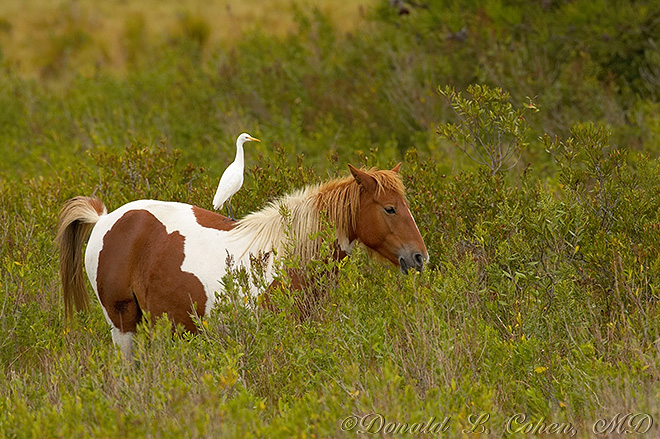
http://www.dlcphotography.net/2005/1D2_02082.jpg


It technically qualifies as a "Perched Bird" although this image is more about the "perch" than the bird.

Technicals: Canon 1DMk2, 600L/f4 IS, ISO 500, f/8, 1/400 (Manual Metering)

In the same sense that when trying to get a memorable image you have to pay as much attention to the background as the subject, with birds, it can be very useful to pay attention to the perch as well.

Also, patience can be a virtue. This shot was taken at Chincoteague, VA, home of the famouos ponies. There were a number of them a fair ways off, with various cattle egrets coming and going. Most of the time the ponies were all jumbled up together, or if one separated away it either didn't have an egret on it, it was facing the wrong way, etc. I stood on the road perhaps a half-hour or so waiting for an opportunity to get a shot with a pony off by itself, reasonably exposed from the grass, and accompanied by an egret properly oriented!

Asher Kelman
October 12th, 2006, 06:45 PM
Wonderful pictures Mike, Bev and Don. The way you planned images is very helpful and makes this thread so valuable. This is the key we must use to elevate what we show on OPF. Thanks for setting a high standard.

Mike's Egret looks miffed!

Asher

Bev Sampson
October 13th, 2006, 05:34 AM
Mike, yours is technically a very good image. I enjoyed it very much and it got me thinking. You state F8 at 1/1600, ISO 400. So how is it that the background comes up so dark. Is it the lens mm being 1200 and fast light falloff because of shallow DOF? I have had this happen and wonder what the technical explanation is. I do like the effect since sometimes I am trying to get a dark background in PSCS with little success.

Don, a beautiful photo. The color is esquisite and the focus is perfect. I don't think I have ever seen this before but then there are no horses at Ding.

In the past there were so many photographers at Ding that it was my intention last season to take a shot of all the photographers. It would have been very impressive but there were scant few. I will keep this forum posted for the 2006-7 season. I guess the word about Ding got around fast.

I have also been to Little Estero Lagoon, Corkscrew, and that little Lakes something or other off of Summerlin with no luck any season that we have been in FL.

Bev

Mike Spinak
October 13th, 2006, 09:41 AM
Thanks, Bev; thanks Asher. I'm glad you like it.

Oiginally posted by Bev Sampson

You state F8 at 1/1600, ISO 400. So how is it that the background comes up so dark. Is it the lens mm being 1200 and fast light falloff because of shallow DOF?

It's not due to any "fast light fall off because of shallow DOF".

To begin with, let me explain how I chose my exposure.

First, I exposed to the right (http://www.luminous-landscape.com/tutorials/expose-right.shtml), as I usually do. So, if you are wondering why the the total exposure was very bright, but the picture does not reflect this, it is because I exposed as brightly as possible, and then "decreased the exposure" during the RAW conversion.

Secondly, I normally would've been more inclined to expose a shot like this at f/8, 1/800, ISO 200, or even f/8, 1/400, ISO 100, however I chose to use a higher ISO/ASA for a couple reasons. One was because I was using a big lens (keep in mind that any vibration is magnified 24x with a 1,200 mm lens), in the wind (lenses this big catch wind like a sail), at a steeply upward angle (which decreases stability)... so I needed an extra-fast shutter speed to ensure that sharpness was not lost to lens movement. The other reason is because higher ISO has a bit less dynamic range... which was desired in this case, both to bring out the visibility of feather detail in a pure white bird, and secondly, to separate the egret from the background.

Anyway, so now that you have the full details about what I did, and why, here's the way that the dark background was a result of this:

The bird is very, very, very white, and sitting in direct sunlight. The background was in shade (I purposely chose an angle where the background showed shade, for this effect). There was a huge difference in brightness between the foreground bird and the background palm fronds. When the exposure was low enough (or, in this case, brought back far enough in the conversion stage) to keep all detail in the bird's white feathers, it was natural for the background to appear quite dark, by comparison. (This is the same type of effect that makes for almost black skies in landscape shots of slickrock formations in the Colorado Plateau.) And then, of course, I raised the contrast a bit in the processing, for the finishing touch.

If any of this was not sufficiently clear, then please let me know.

Cheers,

Mike

www.mikespinak.com

Charles L Webster
October 13th, 2006, 09:58 AM
Perched? As in perched in/on something only?

I have a couple of "standing" bird shots I will share but don't want to mis-post.

Bev Sampson
October 13th, 2006, 10:08 AM
Thanks Mike for the detailed explanation for the very dark background. I usually partial or spot meter a white bird like your egret and then let the background fall where it may. Then as you say, I can lighten or darken the background in the RAW conversion or in PS. Though it is nature, I like a water background better than a very busy tree background. That's the reason I like your photo so much. The background does not complicate the picture. Yes, I am aware of the effects of lens movement and I usually steady my 500 with my left arm.

Are you telling me that when shooting RAW, even though the white feathers on a white bird like yours in intensely bright sun are blown with an exposure for highlights, that they can be recovered in the RAW conversion by decreasing the exposure at that time. I have not found that to be the case as my 1DMKII will blow most highlights over about 235. While there can be some recovery, I find that under exposing white highlights by about 1/3 works better for me.

Mike Spinak
October 13th, 2006, 10:44 AM
Hi, Charles,

Let's leave it up to Bev whether she wants standing birds to fit into her "perched birds" theme, or not.


Hi, Bev,

I usually partial or spot meter a white bird like your egret...

I spotmetered this picture, too. 100% of my pictures are spotmetered and manually exposed.

Then as you say, I can lighten or darken the background in the RAW conversion or in PS.

Just to be clear, I did not selectively darken the background. I just brought down the overall exposure, and globally increased the contrast.

Though it is nature, I like a water background better than a very busy tree background.

Yes, trees are often more difficult than water, compositionally, in regard to keeping the background free of unintended clutter. Ultimately, both can be done. When I want to achieve the "uncluttered background" effect in shots in trees, I often choose to do this by using a very long lens at a large aperture (small number), from close, to achieve shallow depth of field, while looking for cases where the background is in a plane at least five or ten feet back from the bird, and preferably shaded.

...I usually steady my 500 with my left arm.

Yes, when shooting at 1,200 mm, I steady with other arm, among many other techniques (http://www.mikespinak.com/articles/Essays/e002obtainingmaxsharp.html).

Are you telling me that when shooting RAW, even though the white feathers on a white bird like yours in intensely bright sun are blown with an exposure for highlights, that they can be recovered in the RAW conversion by decreasing the exposure at that time.

If the detail is truly blown out, i.e., 255, then the detail is not recoverable by any means. If it is 254, then: yes.

While there can be some recovery, I find that under exposing white highlights by about 1/3 works better for me.

With my 1Ds Mark 2, and converting with Adobe Camera Raw, I have no problem recovering highlight detail, and i do not under-expose. As you can see from this exposure, I "over-expose", without any problems.

Mike

www.mikespinak.com

Bev Sampson
October 13th, 2006, 11:03 AM
Hi, Charles,

Let's leave it up to Bev whether she wants standing birds to fit into her "perched birds" theme, or not.[/url]

Hi Charles, while I am not moderator of this thread, I think my original suggestion in the flying birds thread was to be able to display perched birds and wading birds, birds in nests, birds in trees, feeding birds to be translated as any bird photo that is not a flying bird photo because Mike wanted the flying bird thread to display only flying birds.

I look forward to seeing your bird photos, Charles. Hoping to see a lot of others post here as well.

Bev

Mike Funnell
October 13th, 2006, 04:49 PM
Well, here's my contribution:

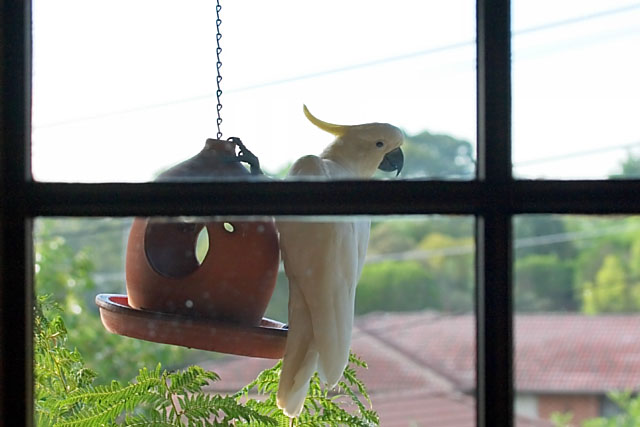
http://static.flickr.com/82/268845248_cb10f48e4e_o.jpg (http://www.flickr.com/photos/mfunnell/268845248/)

This is a Sulphur Crested Cockatoo, visiting the bird feeder on my parents' back veranda and seen through the kitchen window. My mother does like the local birds and there are many very beautiful species that come to visit. I wanted to capture this to show the bird (obviously) with the feeder, the surburban background and the window frame all in one to illustrate, I guess, wildlife in the suburbs and especially at Mum's place - the wild bird, the suburban background and the domestic cosiness of the window.

This was shot with my EF 100-400IS lens (mostly because that's what was on the camera at the time). I chose f8 to bring the surburban backyard background into enough focus to be obvious, but de-focused enough to emphasise the bird and feeder. I adjusted the ISO until I got what I thought was a reasonable shutter speed of 1/250th of a second (they don't hold those poses, you know! so I needed to stop subject movement). The sky is a bit blown out, but really I didn't mind - I just wanted it flat and even, so as not to detract from the bird. I also don't mind the power lines - more suburban backyard effect.

...Mike

Duke Beattie
October 14th, 2006, 11:25 AM
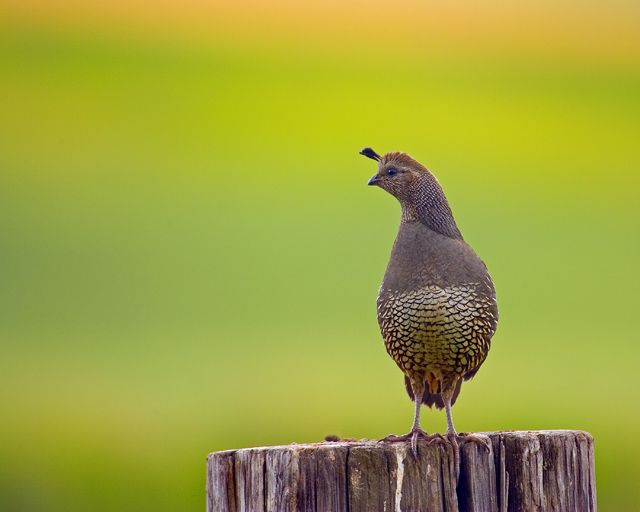
This my contribution.. It was taken from my truck with the camera on a window mount.
It was mid July and the background is a wheat field that is just turning. No post proc blurring on the back ground, just shallow DOF. The bird was trying to distract me from the babies sneaking around the fence post.
http://www.pbase.com/dcbeattie/image/46022016.jpg
Model Canon EOS-1D Mark II
Flash Used No
Focal Length 500 mm Sigma 170-500mm
Exposure Time 1/200 sec
Aperture f/5.6
ISO Equivalent 200

Bev Sampson
October 14th, 2006, 11:36 AM
Very Nice Duke. That's the background I like but never seem to achieve. Dumbie question, what species is the bird. How do you like your 1DMKII?

Bev

Duke Beattie
October 14th, 2006, 12:05 PM
Thanks Bev..
It's a California Quail.. They are generally pretty skittish and don't stand still much. There are a good number of them here(E. Washington). And I love my MkII.. I upgraded from a 300d that I also like. I would like to get a 'good' 500mm lens though. But I got the Sigma cheap..

Bev Sampson
October 14th, 2006, 12:40 PM
Duke, the Canon 500 F4 even with Canon 1.4 TC is a great lens. I went the Sigma route and then just last spring, got the Canon 500. All is not lost because I gave my Sigma 50-500 to my husband who is a happy camper now. I also have the 1DMKII and after getting used to it, love it. Mine is one of the very first issues. One of the main reasons for updating from D60 to MKII was to be able to auto focus with a F4 lens plus 2X TC. Again very nice photo.

Bev

John_Nevill
October 14th, 2006, 04:09 PM
White faced scops owl shot through a cage. The 70-200 f2.8 IS lens was resting against the mesh. Aperture wide open, ISO 125, shutter 1/100sec and post processed in LRWb4.

http://www.eospix.com/images/wfso.jpg

Don Cohen
October 15th, 2006, 11:10 AM
Mike Funnell - thanks for the contribution. Definitely an unusual bird, in an unusual setting. I do understand your wanting to demonstrate the context here, hence the inclusion of the various artificial elements. I don't know if it would have been possible, but perhaps changing the angle of your shot would still allow inclusion of the window-frame, but not have it cut across the bird's body. With regard to the bright sky/background, one option here would be to cut down your ambient exposure, and add flash to illuminate the subject. This might be a little problematic with the window there, but reflection can be avoided if the flash is put directly against, and perpendicular to, the glass.

Duke - a lovely shot. I agree with Bev about the background - smooth and creamy!

John - great detail in this beautiful owl shot. If allowed, a touch of fill-flash would add some light and detail to the face/eyes, balancing it a little bit more against the brightish background. The shadows/highlights tool in PSCS would also help to tone that down if you happen to have that software.

John_Nevill
October 15th, 2006, 02:11 PM
Thanks Don, I agree, it definitely needs a catch light in the eyes.
The original version (http://www.eos-images.com/wp-gallery2.php?g2_itemId=97&g2_enterAlbum=0) has a less bright and saturated background and doesn't compete with owl so much. Maybe I'll revisit it outside of Lightroom.

Charles L Webster
October 16th, 2006, 10:09 AM
I was kneeling shooting a small waterfall in Golden Gate Park, in San Francisco, when I heard a croaking cry immediately behind me. I turned and there he(?) was. Couldn't have gotten closer if I had tried.


http://gallery.photo.net/photo/3752177-md.jpg

Michael Mouravi
October 27th, 2006, 02:11 PM
Here's my neighbor that I met last Spring - a juvenile Red-Tailed Hawk. Saw him while sitting on my porch. Canon 1D and 300mm 2.8 IS. ISO 400, f/2.8 and 1/50s

http://tarkhan-mouravi.com/gallery/albums/misc/hawk1.jpg

Steve Fines
November 16th, 2006, 11:32 PM
Don - the bird on the back perch is fantastic. Really like this one.

Steve Fines
November 16th, 2006, 11:37 PM
Double breasted cormorant, sunset sky

http://www.efines.net/images/fm/VG2L3150_adj_web.jpg

Don Cohen
November 17th, 2006, 06:11 AM
Don - the bird on the back perch is fantastic. Really like this one.

Many thanks, Steve. Also love your Cormorant shot - definitely captures the mood of that scene.