View Full Version : Influence of Painting on Photography
Mike Guthman
March 9th, 2007, 01:40 PM
Hello
I'm looking for some assistance in tracking down a book.
Within the last year or so I was glancing at a book (I believe it was a recently published book) that showed the work of well know painters and then the work of (I believe) well known photographers and showed the similiarities... a classic Hopper and then a photograph that showed Hopper's influence.
At any rate I can't remember the name of the book or the author. Any suggestions on tracking this down would be appreciated.
Thanks
Mike
Angela Weil
March 9th, 2007, 04:27 PM
I'm not sure which book you are referring to.
I have one here that addresses the topic only in relationship to Edward Hopper: 'Visible Truth: Edward Hopper and Photography', G.W. Költzsch and H. Liesbrook (editors), DuMont, 1992, (original title in German: Die Wahrheit des Sichtbaren, Edward Hopper und die Fotografie), albeit from the opposite perspective: The influence of photography on Hopper's painting. It's coffee-table size and has lot's of images (photos, paintings, sketches) as well as numerous essays on painting and photography.
Another one, much smaller, but certainly fun to look at is 'Hopper's Places' by Gail Levin, Alfred A. Knopf, 1985, in which Mrs. Levin (an Art Historian and the curator of the Hopper collection at the Whitney Museum from 1976 to 1984) tracked down the houses Hopper painted and took photographs of them.
If you have seen a book that approaches the topic in yet another direction and includes other artists, I would love to know about it myself.
Angela
Mike Guthman
March 10th, 2007, 06:20 AM
Angela
Thanks for the reply. I'll track these two down.
The book I'm thinking of is much broader in scope. It contains comparisons that are similar to some of those in Ben Lifson's essays but goes further with the concept of the convergence of photography and painting.
Mike
Ray West
March 10th, 2007, 07:30 AM
Mike,
I thought I'd be clever, googled, refined the search and got it down to about 2 million hits ....
But it reminded me that in 1993, Microsoft did something useful, they published much of the National Gallery (London) on cd. Named Microsoft Art Gallery. May be still around, may be others. May be a source of inspiration or disappointment, I guess. Having just loaded it into XP, the images are small on todays high resolution monitors, but you can adjust you display if you really want. I think they have not used a standard image compression method, it is M$, after all.
Best wishes,
Ray
Mike Guthman
March 10th, 2007, 09:09 AM
Hello Again
Ray, you set me on the right track... however, instead of searching with google, I searched on Amazon. That's the good news... I found the name of the book... checked my local library's on line card catalog... they had the book... went down and got.
The disappointing news is that I had the theme of the book wrong. While there are some similarities drawn between painting and photography, the book explores 'convergences' within many sectors of our lives. My quick perusal suggests that this will be a worthwhile read and should help spur some thoughts about composition and subject matter in photography.
I'm glad I was able to find it again
For those who are interested...
'Everything that rises - A book of convergences'
Lawrence Weschler
Mike
Asher Kelman
March 11th, 2007, 03:00 AM
Hi Michael,
Good information. If you are getting the book, could you review it for us. If your preliminary report is positive. let me know and I'll get it too!
Asher
Kevin Bjorke
March 11th, 2007, 03:51 PM
An excellent reference is Henry Rankin Poore's painting composition book Pictorial Composition and the Critcial Judgement of Pictures -- still in print after serving painters and photographers for many many years. If you can find him, his other books are illuminating too. At the risk of too-obviously blowing my own horn, here is a post I wrote a while back on some of his theories. (http://www.botzilla.com/blog/archives/000359.html)
Photography is not painting, of course -- but painting ideas remain strong, particularly in commercial photography and the sort of generic p.net/flickr cliche parade.
Asher Kelman
March 11th, 2007, 10:46 PM
Kevin,
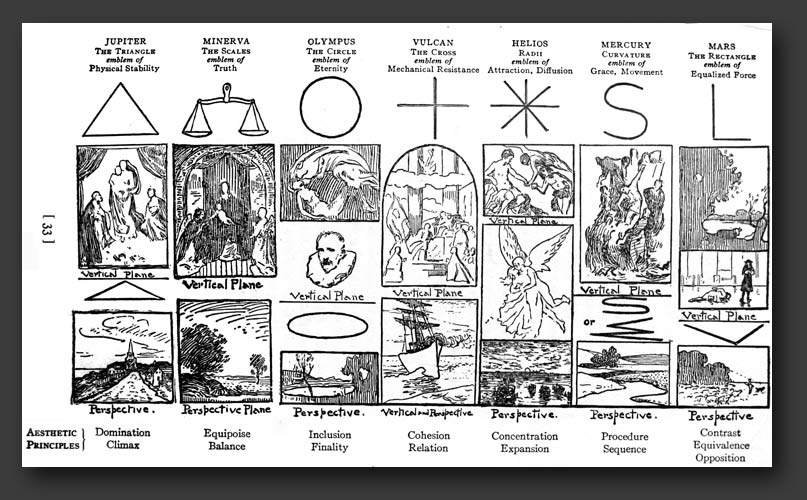
Could you explain AMOT*SL and the chart?
Asher
Kevin Bjorke
March 12th, 2007, 10:05 AM
"AMOT*SL" is my crypto-acronym based on the shapes at the top of of Poore's chart:
http://www.botzilla.com/pix2005/amotxsl.jpg (http://www.botzilla.com/blog/archives/000359.html)
Poore asserts in his 1930 Art Principles in Practice that this chart encompasses all classic strategies in pictorial composition (and by extension, perhaps all useful strategies). In a somewhat surprisingly academie-like way, he also assigns them predefined emotional/aesthetic states and cites connections with the Roman pantheon. The top and bottom of each column compares the forms in both flat-plane/decorative forms and (below) the rendition of the same form in image space when rendering in perspective.
Asher Kelman
March 12th, 2007, 07:12 PM
Interesting diagram! Often, in all this there is some respite from the frustration of us not knowing much about why things work. Also there may be siome gems which we could use. I'd like to know if you are reading this yet and what you are finding out?
Don't get hooked and turn to wizardry! Looks like something Harry Potter might have to learn in the secret witches school. Still, it worked and he made a helll of a lot of money!!
Seriously, I would not dismiss this just because of the diagram but I'd be cautious!
Asher
Kevin Bjorke
March 12th, 2007, 11:22 PM
Yes, my original post was made two years ago. That particular book is out of print, but the "Pictorial Composition" is still around -- I got turned onto it by Mike Johnston, who in turn heard about it from anotehr photographer, a woman portraitist whose name I fail to recall (drat). I consider it, foremost, a historical document, like, say, books on how to write screenplays for those newfangled "moovees" or Ruskin's Laws of the Fesole. But they are all useful for getting a glimpse of what goes on in the heads of image makers, of how their thought processes and actions proceed between vague idea and finished work.