![]() |
|
HOME
FORUMS
NEWS
FAQ
SEARCH
|
|
|||||||
| All other DSLR's and Four Thirds, 4/3 All DSLRs excluding Canon and Nikon mounts ie Sigma, Pentax, Olympus, Sony, Leica R Back DSLRs and 4/3 System |
![]() |
|
|
Thread Tools | Display Modes |
|
#31
|
|||
|
|||
|
Quote:
__________________
Regards, Murray Journeys to Patagonia, Antarctica, Falkland Is, Iguazu Falls, Easter Is and now Japan Slide shows of other images, mainly live music |
|
#32
|
|||
|
|||
|
Quote:
I don't see the point in having the 20mm and 25mm, the angle of view is very similar. I would also like to point out that Sony has an optical viewfinder for the Nex 3 or 5 and the 16mm and that these optical viewfinder are not always very convenient: they make the camera quite a lot more bulky in a bag and you don't get any info on what the camera is doing. |
|
#33
|
|||
|
|||
|
Quote:
Hi Jerome, Yes, the issues are less problematic on half frame cameras than full frame, but there is a lot of anecdotal comment on fora that people are not getting a step up in 'image quality' from M lenses compared to the system lenses. Plus, you then have to deal with manual focus on a body that is fundamentally designed for autofocus. I agree that 20 and 25 are quite close, but I use both 35 and 50 (eq 17 and 25) quite distinctly. I supect that 17 to 20 is fairly manageable swap. Also, I know Fahim uses 28 on his M8, which is about half way between 17 and 20 on the M4/3s bodies. (and having said that, perhaps a 33 would be a better replacement for his 50!) Mike |
|
#34
|
|||
|
|||
|
Quote:
About manual focus: the Nex series has introduced a function called "peaking" which really changes the way one focuses on these cameras. It makes manual focus much, much easier. Since the function has been standard on video cameras for years, I expect the other manufacturers to do the same relatively soon. |
|
#35
|
|||
|
|||
|
Fuji decided to surprise us with a new camera system dedicated to primes (their optical viewfinder construction precludes the use of zoom lenses, so the list becomes as follows:
Sony NEX Fuji X-Pro1 Olympus-Panasonic µ4/3 Samsung NX Leica S (not a compact and light system, but a relatively new system with only primes) __________________fish_______18_______24_______28_______35______40_______50______75______90________135_____ NEX_______________2.8________2.8_____2.8________________1.8________3.5M ________1.8S_______________________ Fuji_X1_______________________________________2.0________________________1.4_____________2.4_______ ________ Olympus _____________________________2.0________________2.8______________________________1.8_______________ Panasonic_________3.5__________________________2.5______________1.7______1.4_____________2.8MS______________ Samsung______________________________2.8___________________________2.0______________________________________ Leica_S2_______________________________________2.5 ________________________2.5________________2.5M___ ____3.5 Small lenses (so called "pancakes") are in magenta. Macro lenses have the letter M, lenses with Optical Stabilisation the letter S. Sony has 2 converters for the 16mm, making it into a wide-angle and fisheye primes, those are listed in grey (are they primes or not?). |
|
#36
|
|||
|
|||
|
Quote:
I will try with lists of newly available lenses. The focal length for an equivalent FOV on a 36x24mm film/sensor is added in brackets. DA: 14/2,8 (21) 35/2,4 (52) DA*: 55/1,4 (80) DA limited (40 is _the_ pancake, 21 and 70 can be counted as well): 15/4 (22) 21/3,2 (33) 40/2,8 (60) 70/2,4 (105) DFA (both are macro lenses): 50/2,8 (75) 100/2,8 (150) FA: 35/2,0 (52) FA limited: 31/1,8 (43) 43/1,9 (65) 77/1,8 (116) If we put all 36x24mm film/sensor equivalent FOV focal lengths together, the list looks like this: 21 22 33 43 52 52 60 65 75 80 105 116 150 The largest gap for me is from 22 to 33. Is it this what you wanted to say? Best regards, Michael |
|
#37
|
|||
|
|||
|
Quote:
__________________fish_______16_________24_______28_______35______40_______50______75______90________135_____ Pentax lim___________________________4________________3.2___________________2.4_2.8_____1.4____2.4_________ ________________________________2.8_______________ __________________1.8_____2.8M__1.9_1.4________1.8________ |
|
#38
|
|||
|
|||
|
Quote:
__________________
Regards, Murray Journeys to Patagonia, Antarctica, Falkland Is, Iguazu Falls, Easter Is and now Japan Slide shows of other images, mainly live music |
|
#39
|
|||
|
|||
|
This is more about the NEX 5N itself than primes, as I only tried one expensive Zeiss 24 mm and yes it was perfection.
I have been using the NEX 5N for the past week. I left my Canon armory at home and just had the NEX 5N with the 18-55 (X1.5 for APA-C). Marvelous freedom to compose all day with no schlepping gear. I don't think my pictures are any less useful except I did need the 24mm T/S II when shooting a model in a park and wanted the b.g. Frankly, I found that the focus was so fast and the camera so light but with just enough balance and heft, that I was very, very pleasantly surprised. After a day, my GXR, with the far superior GXR f 2.8 50mm macroi lens, did not even get into my coat pocket. It's unbeatable for macro and slow shooting but it breathes to slowly for fast-paced work. I'll now try the NEX with more primes. I did try a 24mm Zeiss, but it was a little expensive for me for just a fun trip to NY. What this exercise tells me is that fast focus can trump almost anything else in work with people. If a prime series does that with these wonderful APS-C sensors, there will be lots of winners. Asher
__________________
Follow us on Twitter at @opfweb Our purpose is getting to an impressive photograph. So we encourage browsing and then feedback. Consider a link to your galleries annotated, C&C welcomed. Images posted within OPF are assumed to be for Comment & Critique, unless otherwise designated. |
|
#40
|
|||
|
|||
|
Quote:
I know your next answer: people prefocus on the Leica M. In that case "focus" (or lack of it) is instantaneous. But nothing precludes doing the same on the GXR: youtube example. But you did not use that function and I would think that few users actually use prefocus on the GXR or similar cameras in the field, while many more Leica M users do so. Why the difference? Because of the ergonomics. Todays cameras are technically excellent. The differences in quality between them is too small to be significant in the field for the overwhelming majority of pictures. What makes a camera sing is how well the controls are arranged and this is a matter of personal preference: some people are quite happy with the GXR's manual focus. The ergonomics work for them. |
|
#41
|
|||
|
|||
|
Quote:
I was brought up on manual focus with the Retina IIB and a 35mm lens. I beleive it had click stops but I can't swear to that. I knew how to turn the focus and get thing sharp just be looking ahead and moving by feel. With Leica lenses, there's often a lever which gives orientation. With my Bronica, again I can focus by the position of the ring. I need to invest some effort with the GXR on manual to be fair. But for critical work I'd use the GXR over the NEX for 50mm focal length, at least for now. One bad thing about modern lenses is the fly by wire "manual" rings. We'd be better off with actual manual controls and several turns. Asher
__________________
Follow us on Twitter at @opfweb Our purpose is getting to an impressive photograph. So we encourage browsing and then feedback. Consider a link to your galleries annotated, C&C welcomed. Images posted within OPF are assumed to be for Comment & Critique, unless otherwise designated. |
|
#42
|
|||
|
|||
|
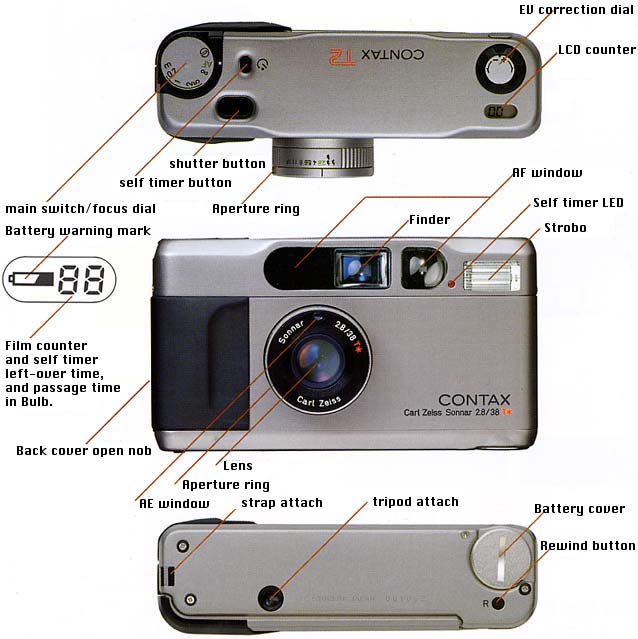
Indeed, free-turn focus wheels lack any reference for the photographer. The same is true from menu-based systems. They can be used to prefocus, but not to focus by estimate and feel.
An interesting solution is used in the Sigma DP1/2: there is a focus wheel separate from the lens. It is not free-turn, there is a stop at infinite. Unfortunately, the angle of turn is very small between infinite and 2m. That solution is not new, BTW. The first camera I saw it used is the Contax T2:
|
|
#43
|
|||
|
|||
|
Bit confused about the diagram, there is no fast 35mm for the NEX system unless I've missed something.
__________________
Ben Rubinstein Website: http://www.timelessjewishart.com Blog: http://thedustylenscap.com |
|
#44
|
|||
|
|||
|
The Zeiss 24mm f/1.8 has an angle of view equivalent to a 35mm lens on a full frame camera.
|
|
#45
|
|||
|
|||
|
There have been some changes on the compact mirrorless camera market. Sigma announced two new prime lenses, a 19mm and a 30mm, both open at f/2.8 and small enough to be considered as "pancakes". The lenses are available for the NEX and µ4/3 systems, so become equivalents of:
-a 28mm and 50mm for NEX and -a 38mm and 60mm for µ4/3. The ∑19mm is of little interest for the µ4/3 system because of the competition of the extraordinary 20mm pancake from Panasonic, but will be a perfect 28mm equivalent for the NEX system. The two Sigma lenses are cheap and, if the MTF curves published on Sigma Japan site any indication, should be quite good. Samsung has announced a 20mm f/2.8 pancake for their NX system (30mm equivalent) and I corrected the aperture of the 16mm (24mm equivalent) to f/2.4. I wrote f/2.8 by mistake. The list becomes as follows (in "35mm equivalent focal lengths"): Sony NEX Fuji X-Pro1 Olympus-Panasonic µ4/3 Samsung NX __________________fish_______18_______24_______28_______35______40_______50________75______90________135_____ NEX_______________2.8________2.8_____2.8______∑2.8________1.8___________3.5M∑2.8___1.8S_______________________ Fuji_X1_______________________________________2.0__________________________1.4_____________2.4M____ _____________ Olympus _____________________________2.0________________2.8___∑2.8____________∑2.8_________1.8_______________ Panasonic_________3.5__________________________2.5______________1.7______1.4_______________2.8MS______________ Samsung______________________________2.4_________2.8______________________2.0_______________________________ Small lenses (so called "pancakes") are in magenta. Macro lenses have the letter M, lenses with Optical Stabilisation the letter S. Sony has 2 converters for the 16mm, making it into a wide-angle and fisheye primes, those are listed in grey (are they primes or not?). |
|
#46
|
|||
|
|||
|
Indeed the 30mm is sharp corner to corner. A perfect lens.
|
|
#47
|
|||
|
|||
|
Quote:
Assuming, just for the moment, that one gets pretty much the same 8x10 pictures from µ4/3 and APS-C sized sensors, could you now bring in cost and AF. With these considerations, which camera systems can be equipped for the least outlay of cash and still have coverage of focal lengths and AF? Thanks, Asher
__________________
Follow us on Twitter at @opfweb Our purpose is getting to an impressive photograph. So we encourage browsing and then feedback. Consider a link to your galleries annotated, C&C welcomed. Images posted within OPF are assumed to be for Comment & Critique, unless otherwise designated. |
|
#48
|
|||
|
|||
|
I don't understand the question. Everyone of the cited lenses is AF. They are all available in the native mount. As to cost of lenses, it really depends on what coverage one wants, what aperture is desired and whether zooms are allowed: what do you mean by "coverage of focal lengths"?. As to cost of bodies, a second hand Olympus EP-1 or NEX 3 is really cheap...
(Since you are in the USA, and because prices are a bit different depending on country, I checked on amazon.com: you can get an Olympus EP-1 or NEX 3 body for 190$ today). |
|
#49
|
|||
|
|||
|
Quote:
Let me clarify my question. I really like the new batch of compact cameras. The Canon and Nikon DSLR's are so heavy to lug around all day. My experience is limited to just two brands, Ricoh and Sony so I was wondering, overall, which brand offers a good range of prime AF lenses without breaking the bank, preferably APS C sized sensor. Ricoh: I love the Ricoh GXR, solidly built, with it's 50 mm f 2.5 Macro lens and enclosed sensor unit. The pictures are on a par with full frame camera for most intents. However, the range of primes is limited to that 50 mm and a 28mm APS C units. Zooms are wonderful but have tiny sensors. One can use the M-mount adapter and leverage Leica lenses one owns, but then the focus is manual. Sony: My experience with the Sony NEX 5N was a quick wonderful romance. The 18-55 zoom, (x1.5) was all I had but it was really practical for a New York "guerilla" shoot. The f 2.0 28mm Zeiss lens offered was just too expensive and has no image stabilization. The 16 mm, f 2.8, (equivalent to 24mm), was not in stock and that's the line up; rather limited! Of course, they have the 2X adapter and ultrawide and fisheye convertors, but these aren't primes. One can use the large heavy prime lenses from the Sony alpha DSLR with an adapter, but hardly practical for a compact system. So I'm looking out for a fine system with compact AF lenses covering the 35mm equivalent focal lengths of 14-16mm to 120 mm at least. Asher

__________________
Follow us on Twitter at @opfweb Our purpose is getting to an impressive photograph. So we encourage browsing and then feedback. Consider a link to your galleries annotated, C&C welcomed. Images posted within OPF are assumed to be for Comment & Critique, unless otherwise designated. |
|
#50
|
|||
|
|||
|
Quote:
The real strength of the NEX system is not the lenses, but the NEX 7 camera with its viewfinder and 3-wheels setup system. Quote:
|
|
#51
|
|||
|
|||
|
Quote:
Rokina fisheye f3.5 8mm, 12mm equivalent MF Sony 16mm as you have described, 24 mm equivalent Zeiss 24mm 1.8, 36mm equivalent, AF $999.99 Sony 30mm f/3.5 Macro Lens, 45mm equivalent, AF Sigma 30mm f2.8, 45mm equivalent, AF Zeiss 50mm 1.8 AF 75mm equivalent So that comes out to 12mm, 24mm, 36mm, 45mm and 75mm prime coverage, with the fisheye being MF. That's pretty good. but where did you find your 28, 35 and 50 mm equivalent primes or are these more like poetic license designation in coverage? Quote:
Asher
__________________
Follow us on Twitter at @opfweb Our purpose is getting to an impressive photograph. So we encourage browsing and then feedback. Consider a link to your galleries annotated, C&C welcomed. Images posted within OPF are assumed to be for Comment & Critique, unless otherwise designated. |
|
#52
|
|||||
|
|||||
|
Quote:
Quote:
Quote:
Quote:
Quote:
|
|
#53
|
|||
|
|||
|
Thanks Jerome for your detailed knowledge. This is most helpful.
Quote:
Asher
__________________
Follow us on Twitter at @opfweb Our purpose is getting to an impressive photograph. So we encourage browsing and then feedback. Consider a link to your galleries annotated, C&C welcomed. Images posted within OPF are assumed to be for Comment & Critique, unless otherwise designated. |
![]() |
| Bookmarks |
| Thread Tools | |
| Display Modes | |
|
|
Similar Threads
|
||||
| Thread | Thread Starter | Forum | Replies | Last Post |
| Camera shake | Doug Kerr | Imaging Technology: Theory, Alternatives, Practice and Advances. | 12 | February 20th, 2012 09:26 AM |
| White balance for the iPhone camera | Doug Kerr | CM Theory and Practice | 0 | October 15th, 2010 08:26 AM |
| News: Camera that auto stitches and auto builds from multiple shots! | Asher Kelman | Breaking News | 1 | March 3rd, 2009 06:30 AM |
| The 50 D is here...where's the 5dMk2???? | Kathy Rappaport | Breaking News | 30 | August 28th, 2008 08:40 AM |
| Michael Reichman's 2006 assessment of MF Digital Systems, where are we now? | Asher Kelman | Medium Format & Large Format Cameras | 10 | October 16th, 2007 06:43 PM |